
Google satellite sends first AI haiku from orbit using a TPU and Gemma 4
Google's prototype satellite from Project Suncatcher has sent an AI response from space for the first time: a haiku generated by the Gemma 4 model on a data-center chip. The test aims to show whether AI data centers in space could one day be realistic.
What this is about
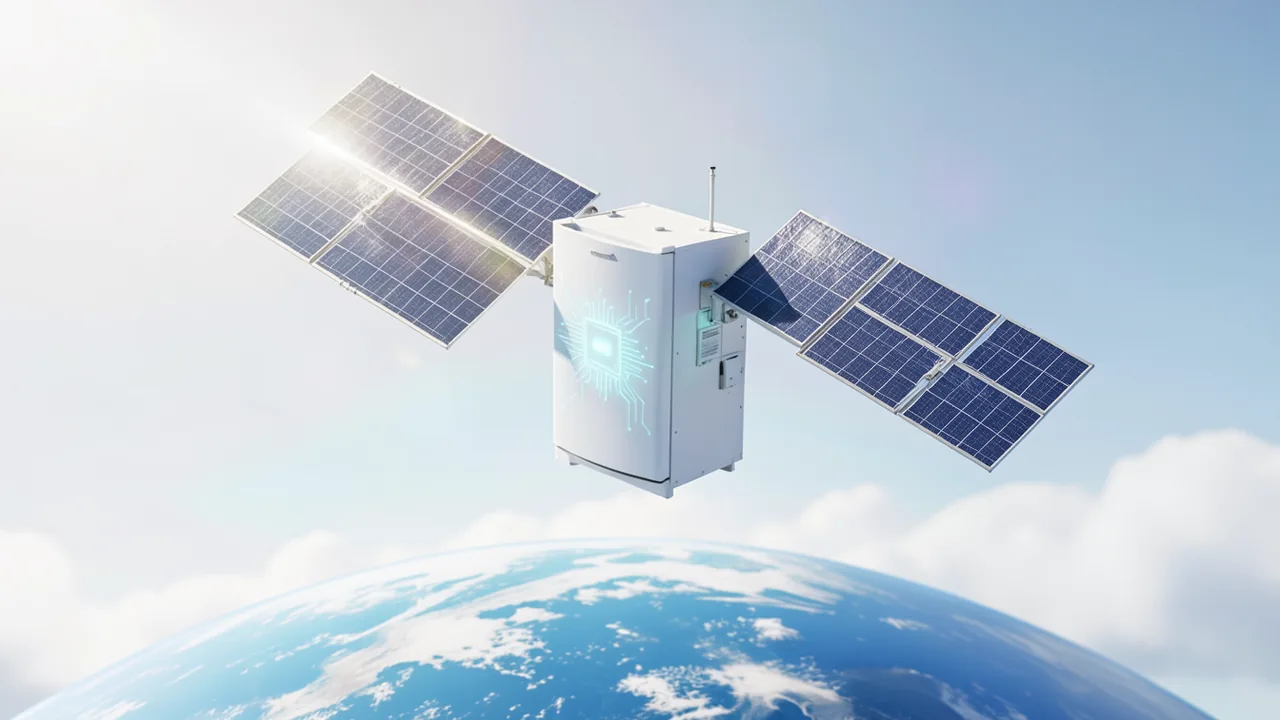
On October 30, 2026, Google announced that its prototype satellite from Project Suncatcher has sent an AI response from orbit for the first time. The open language model Gemma 4 ran on board on a data-center-class TPU (Tensor Processing Unit, a specialized chip designed by Google for AI workloads). Travis Beals, Senior Director of Paradigms of Intelligence at Google, called it the mission's "Hello World" milestone.
During a pass over a ground station, the team uplinked a prompt asking for a haiku about being in space. As the satellite flew over Svalbard (Norway), the answer came back:
Blue marble below / Data streams in silent grace / Starlight feeds my core.
The team then tried limericks about space and telemetry queries, in which the system reported the technical status of the payload. A Google spokesperson told TechCrunch the satellite is operating nominally, meaning as planned.
Launch and commissioning
The satellite launched on October 1, 2026, on a SpaceX Falcon 9 rocket as part of the Transporter-18 rideshare mission (many small satellites share one rocket). According to TechCrunch, more than 100 other spacecraft flew along. gcn.com cites 130 payloads and a launch from Vandenberg Space Force Base. The prototype was built with the Earth-observation company Planet.
After launch, the team worked through a commissioning checklist: powering on the host and TPU trays and running initial machine-learning tests. According to TechCrunch, checking out the subsystems took about three weeks. A peer-reviewed paper on the research behind the mission has since been published in the journal Joule.
What's on board
The sources differ on some details:
| Detail | Source |
|---|---|
| A single TPU, up to 1 kW of power, runs about 20 minutes at a time | TechCrunch |
| Four Trillium TPUs (performance of a Cloud TPU v6e-4 slice), about 1 kW of solar power, bursts of about 15 minutes | gcn.com |
| Four TPUs | Gizmodo |
All sources agree on one point: the chips' power demand allows only short operating windows, which makes the already tricky communication with Earth even harder. gcn.com calls the satellite an "MVP," roughly the size of a refrigerator, with a planned operating life of one year and re-entry in about six years. Only gcn.com reports that Gemini models run benchmarks there. The primary source names Gemma 4.
Why chips in space are hard
Google tested the hardware on the ground beforehand:
- Launch: The flight to low Earth orbit takes about 10 minutes, with sustained acceleration of up to 10 times Earth's gravity. Individual components such as the TPU chips can experience 50 to 100 g. The team shook the satellite on all three axes to simulate this.
- Radiation: The Trillium TPUs ran AI workloads in a proton beam at UC Davis's Crocker Nuclear Laboratory. The team watched how errors such as "bit flips" (a single bit in memory flips, which can silently corrupt data) affected the tasks. The chips tolerated a higher total dose than a five-year mission would deliver. According to TechCrunch, the ground tests suggested radiation barely disturbs inference (running a finished model) but would be more of a problem for training. Now that can be checked in real conditions.
- Cooling: In a vacuum there's no airflow, so heat can only be shed through radiators. Google is relying on heat pipes plus radiators, so far tested only in a thermal vacuum chamber.
The idea behind it and next steps
Suncatcher was unveiled on November 4, 2025, as a long-term research "moonshot." In low orbit, satellites get near-constant sunlight and, according to Google, can generate up to eight times more solar power than on Earth. Future satellites are meant to carry dozens of TPUs each, fly in clusters (gcn.com: 81 satellites within a one-kilometer radius) and communicate by laser. Google compares the required pointing accuracy to hitting a coin-sized target from several miles away while both points are moving. These laser links are due to be tested in 2027 with two satellites.
Costs and competition
According to The Next Web, price is the main problem: Google's own research estimates that launch costs would have to fall to about $200 per kilogram for space computing to compete on cost. TechCrunch reports that Suncatcher researchers estimated in a peer-reviewed analysis that SpaceX would need to fly Starship 1,800 times to achieve learning-driven cost reductions comparable to those of earlier rockets. On the competition side, the Nvidia-backed startup Starcloud put an H100 into orbit in November 2025 and ran Google's Gemma on it. SpaceX also plans orbital data centers. According to TechCrunch, Alphabet holds a significant stake in SpaceX.
Our take
The haiku is first and foremost a proof of function: a data-center chip runs in orbit and answers prompts. That proves neither economic viability nor scalability. Still open are long-term behavior under radiation, cooling under real conditions, the laser links and launch costs. gcn.com stresses that Google has given no timeline for a commercial service. TechCrunch frames Suncatcher as infrastructure for the 2030s. The sources partly contradict each other on technical details (number of TPUs, operating time), so treat those figures with caution.
Related videos
Sources
- Unite.AI unite.ai
- TechCrunch – AI techcrunch.com
- Bing News (es-ES) unite.ai
- gcn.com gcn.com
- thenextweb.com thenextweb.com
- gizmodo.com gizmodo.com
- The Verge – AI theverge.com
- Bing News (ja-JP) unite.ai
Ask the AI assistant
Questions about this article, installation or background? Our assistant knows this page and runs on our own machine, not in someone else's cloud.
The Assistant is an AI (Gemma 4) and can make mistakes – please check important details against the source. Questions are used only to generate an answer and are deleted after one hour. Please don't enter any personal data.



Comments
What do you think? Already tried it? Write it here, no sign-up needed.
Comments are public. Links aren't allowed, and we delete abusive posts. You can delete your own comment at any time in this browser. Learn more in the Privacy Policy.