
GPT-6.1 Terra: OpenAI's mid-tier model nearly matches Astra at a tenth of the price
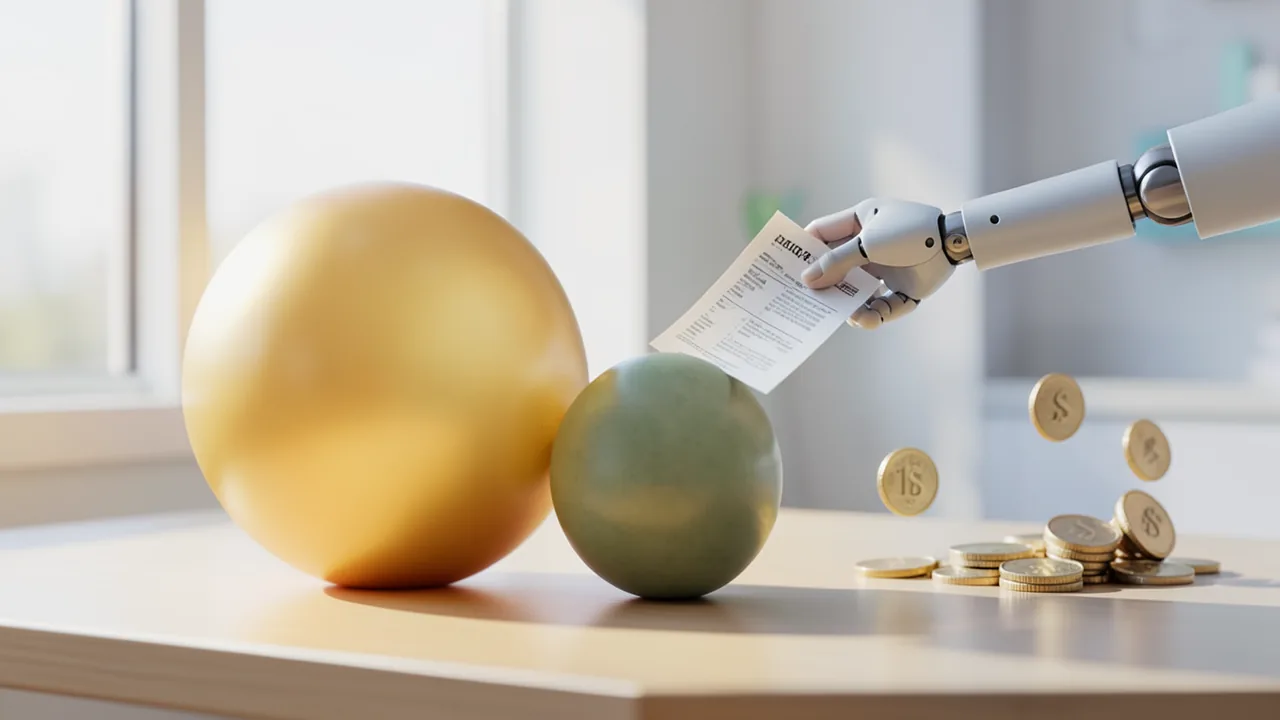
OpenAI has released GPT-6.1 Terra, a mid-sized model that operates computers, understands images and gets close to the flagship GPT-6 Astra in many tests, at a tenth of the price. Since November 3, Terra has even been taking over work in OpenAI's expensive Dots assistants, because they burn through so much compute.
What's going on
On October 26, 2026 (US time), OpenAI released GPT-6.1 Terra, a mid-sized model built mainly for computer work: operating software, filling in forms, analyzing images and technical drawings, and writing text. It replaces GPT-5.6 Terra, which came out this summer. Paying users on the Plus, Pro, Enterprise and Edu plans can use it in ChatGPT Work and in Codex, OpenAI's coding environment. Developers can call it through the API as gpt-6.1-terra. The weights aren't public, so the model only runs on OpenAI's servers.
Just over a week later, it became clear why OpenAI cares so much about a cheap mid-tier model. According to a report by boerse-global.de (published on ad-hoc-news.de), OpenAI started moving work from its new Dots assistants off the expensive GPT-6 Astra flagship and onto Terra on November 3.
The model family: Astra, Sol, Terra, Luna
OpenAI's model names have become hard to keep track of. Here's how Android Authority sorts them. GPT-6 Astra is currently the heavyweight and the most capable model. A 6.1 version of it has been delayed over unspecified concerns. GPT-6.1 Sol is basically "Astra on a smaller budget" and came out about a month before Terra. GPT-6 Luna is mostly about keeping costs as low as possible. Terra sits between Sol and Luna. In Android Authority's words, it's meant to be the porridge that's "just right". According to the main source, OpenAI developer Thibault Sottiaux announced the expanded lineup.
Under the hood, Terra is a reasoning model, according to Marktechpost. It "thinks" through intermediate steps before it answers. You can set how much it thinks, from "none" to "max", and the default is "medium". The model takes text and images as input and replies in text. Its context window, meaning how much text it can keep in view at once, is 1.05 million tokens, and it can output up to 128,000 tokens. Tokens are the chunks of text a model reads and writes. Its knowledge cutoff is June 1, 2026. Tools work through OpenAI's Responses API: computer control, a hosted shell, a code interpreter, web search, file search and MCP (a standard for connecting AI models to outside services).
OpenAI's typical use cases are high-volume work: reading incoming invoices and entering them into accounting software, matching product photos to the right catalog entries, or interpreting technical drawings.
Pricing: a tenth of Astra
The price is the real story here. All figures are per million tokens:
| Model | Input | Output | Cached input |
|---|---|---|---|
| GPT-6.1 Terra | $1 | $5 | $0.05 |
| GPT-6.1 Sol | $2 | $10 | $0.10 |
| GPT-6 Astra | $10 | $50 | $1 |
| Claude Opus 5.5 | $4 | $20 | – |
| Claude Sonnet 5.5 | $2 | $10 | – |
"Cached" means parts of a request that have already been processed, such as a long system prompt that doesn't change, are stored and billed at a much lower rate. According to Marktechpost, batch and flex modes (for requests that don't need an immediate answer) are another 50 percent cheaper, and a fast mode costs double. For requests over 272,000 input tokens, the input price doubles and the output price goes up 1.5x. Help Net Security says that's half the price of the previous GPT-5.6 Terra.
Benchmarks: close to Astra, weaker at coding
All of these numbers come from OpenAI's own charts. Nobody has published independent measurements yet. Marktechpost compiled the figures:
| Benchmark (max reasoning) | Terra | Sol | Astra | Claude |
|---|---|---|---|---|
| Agents' Last Exam v1 | 60.0% ($1.01/task) | 58.6% ($2.00) | 59.3% ($7.24) | Opus 5.5: 63.2% ($8.82) |
| MMMU-Pro (vision) | 85.5% | 86.3% | 86.7% | – |
| OSWorld 2.1 offline | 74.2% | 78.0% | 80.9% | Sonnet 5.5: 83.9% |
| Terminal-Bench 4.0 | 50.3% | 55.9% | 58.2% | Sonnet 5.5: 70.6% |
| Terminal-Bench-Science 0.1 | 58.3% | 57.0% | 68.1% | Opus 5.5: 63.3% |
Agents' Last Exam tests professional computer tasks, such as turning architectural drawings into a 3D model. Even on the medium setting, Terra hits 57.6 percent at $0.29 per task. That matches Astra, which costs $4.82 to get there. GPT-5.6 Terra managed 42.6 percent at $0.84. MMMU-Pro tests how well a model understands images and diagrams. Terra trails Astra by just 1.2 points here, at $0.012 per task instead of $0.065. OSWorld measures how well a model can operate a desktop computer.
OpenAI says that at the maximum setting, Terra is more than three times as token-efficient as Claude Opus 5.5 and costs a quarter of its per-token price. That makes it roughly nine times cheaper per task. OpenAI also says Terra finishes tasks more than three times faster than Astra and Sol.
OpenAI also reports a big drop in the error rate. On an internal set of deliberately misleading prompts, it fell from 53.6 percent (GPT-5.6 Terra) to 16.7 percent at low reasoning effort, which still means one in six prompts goes wrong. At maximum effort, it fell 18 points to 4.3 percent. Marktechpost notes that the test is built to be hard on purpose, so real-world error rates will look different.
Coding is the weak spot. On Terminal-Bench 4.0, which has coding agents solve command-line problems, Terra scores 50.3 percent. That's more than double its predecessor (21.5 percent), but it's well behind Sol, Astra and especially Claude Sonnet 5.5. As Help Net Security points out, that leaves almost half the tasks unsolved. OpenAI itself still recommends Sol or Astra for the hardest coding work. On scientific coding tasks (Terminal-Bench-Science), though, Terra beats Sol at a lower cost ($4.15 instead of $5.47 per task). According to Help Net Security, it also comes within five points of Opus 5.5 for less than a fifth of Opus's estimated cost.
Safety: the highest cyber risk level
Help Net Security flags something notable: OpenAI rates Terra at "Critical" for cybersecurity in its Preparedness Framework, the company's internal rulebook for assessing risk. This is the higher of two levels. It applies when a model with tools can, without human help, build working exploits for unknown vulnerabilities (zero-days) across many hardened, real-world critical systems, or plan and carry out a new attack end to end from nothing more than a rough goal. Astra was the first model OpenAI rated this way, on September 1, 2026. Terra inherits the safeguards built for Astra. OpenAI says Terra held up well in its tests against prompt injection (hidden malicious instructions meant to pull the model away from its task) and is more honest about its own limits than its predecessor.
Dots: why OpenAI needs to save compute
The main source shows how OpenAI uses Terra itself. Dots, unveiled on September 29, are AI assistants you instruct over a phone call. They keep working on tasks like research or coding on their own after the call ends. Unlike regular chatbots, each Dot runs on its own cloud computer. Adam Fry, head of consumer for ChatGPT, admitted in New York on November 2 that Dots is extremely compute-intensive. Fry says ChatGPT's voice mode alone has 250 million users a week.
Until now, everything in Dots ran on Astra. Since November 3, an automatic task router, a kind of switch, has been deciding whether Astra or Terra handles a request based on how hard it is. Dots is currently only included in the ChatGPT Pro plan at $100 a month (159,000 won in South Korea, about $120). Since October 28, you can also use the service via iMessage and RCS in the US, and since October 30 in Canada and Mexico. It's rolling out gradually in Brazil.
The cost pressure hits the whole industry. According to the main source, xAI CEO Elon Musk called Grok's operating costs unsustainable relative to revenue and scaled back its compute capacity. Anthropic's amended IPO filing (S-1) lists purchase commitments of $895.4 billion, mostly for compute infrastructure. OpenAI relies mainly on Nvidia chips and plans its own chips for 2027 under the codename "Jalapeno". Its most recent raise brought in about $11 billion at a valuation of around $1.25 trillion.
The bigger picture
Terra is less a leap at the top of the leaderboard and more a price crash. OpenAI says that for many everyday computer tasks, like analyzing documents, operating interfaces and understanding images, it delivers nearly Astra-level quality at a fraction of the cost. If your company automates that kind of work at scale, the math changes a lot. And the fact that OpenAI immediately put the model into its own expensive assistants shows clearly how much compute costs now shape product design.
There are caveats, though. Every benchmark figure comes from OpenAI, and the parameter count and hardware remain secret. On coding, Terra is clearly behind Anthropic's Claude Sonnet 5.5, which costs the same as Sol. And when a model this cheap lands at the highest cyber risk level, it shows how quickly dangerous capabilities are spreading into cheap, mass-market use. How well the safeguards hold up in practice can't be checked from the outside.
Sources
- Bing News (de-AT) ad-hoc-news.de
- helpnetsecurity.com helpnetsecurity.com
- androidauthority.com androidauthority.com
- marktechpost.com marktechpost.com
Ask the AI assistant
Questions about this article, installation or background? Our assistant knows this page and runs on our own machine, not in someone else's cloud.
The Assistant is an AI (Gemma 4) and can make mistakes – please check important details against the source. Questions are used only to generate an answer and are deleted after one hour. Please don't enter any personal data.


Comments
What do you think? Already tried it? Write it here, no sign-up needed.
Comments are public. Links aren't allowed, and we delete abusive posts. You can delete your own comment at any time in this browser. Learn more in the Privacy Policy.