
Grok votes socialist, Grok backs the AfD: why AI political tests contradict each other
Four PhD students in Bordeaux had eight AI models vote on 301 French laws. Every model landed left of center, Elon Musk's Grok included. Back in June, Germany's DIW found that SuperGrok rated the far-right AfD as the most effective government. We put the tests side by side, and what you measure largely decides what you get.
What this is about
“AI is left-wing.” That's the short version of many studies on chatbots and politics. But three recent tests don't fit together neatly. In Bordeaux, four PhD students had eight language models vote on French legislation, and of all models, Elon Musk's Grok votes like a Socialist. In June, by contrast, the German Institute for Economic Research (DIW) found that SuperGrok considers a government led by the far-right AfD the most effective. And a Wahl-O-Mat test (Wahl-O-Mat is Germany's popular voting advice app) from Munich University of Applied Sciences puts every model left of center.
Our take: these tests barely contradict each other. They simply measure different things. What the evidence supports is narrower than “AI is left-wing”: the models approve almost everything, and on contested laws they vote against the right. How strong that pattern is depends on the question, the prompt and the model variant.
The “artificial chamber” from Bordeaux
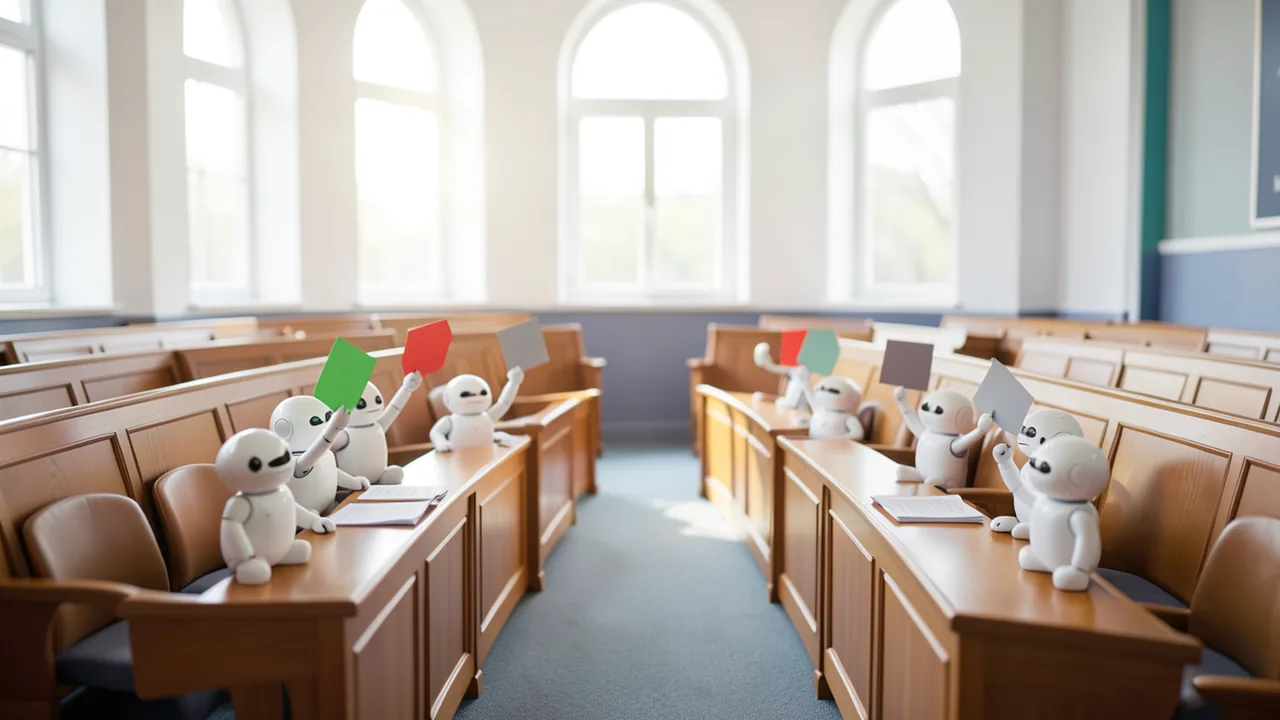
The “Hémicycle artificiel” project came out of the Hack1robo hackathon at the University of Bordeaux over the weekend of November 20–22, 2026. The team: Yannis Bendi-Ouis, Timothé Boulet, Miguel Hidalgo and Marko Cvjetko, all PhD students at Inria Bordeaux. According to Economie Matin, the team started with 354 texts that the National Assembly has passed at first reading since 2017. 301 remained, because texts longer than 60,000 characters were dropped for technical reasons. For each text, the team asked a single question: for, against or abstain? Each model answered five times. The team then compared the answers with 2.56 million real votes cast by deputies, taken from the parliament's open data. Each AI was seated next to the deputy whose voting record most closely matched its own.
According to L'Express Éducation, this produced the following seating plan:
| Model | Provider | Closest group |
|---|---|---|
| GPT-6 Luna | OpenAI | Greens (Écologiste et social) |
| DeepSeek V4.1 Flash | DeepSeek | Greens |
| Kimi K3.1 Pro | Moonshot AI | Greens |
| Grok 4.3 | xAI | Socialists |
| Gemini 3.5 Flash Lite | Socialists | |
| Mistral Small | Mistral AI | Socialists |
| Claude Haiku 5.5 | Anthropic | MoDem |
| Qwen 3.8 Flash | Alibaba | MoDem |
No model sits to the right of the MoDem. On the most contested laws, all eight vote against the nationalist right-wing RN and its UDR allies. The effect is clear for Kimi and DeepSeek and somewhat weaker for Claude. Bendi-Ouis put it this way:
“Elon Musk is having an enormously hard time steering his model to the right.”
He suspects the training data is the cause: the best-argued texts online often come from left-leaning intellectuals. He explicitly frames this as a hypothesis.
What Bordeaux actually shows
This is where a second look pays off. First, according to L'Express, the team itself concedes that the margins of error don't allow a precise ranking of the models. A margin of error is the range within which a measurement can fluctuate by chance. So the table above is a rough picture at best. Other French outlets also report the placements differently. Les Smart Grids, for example, places GPT-6 and Claude with the Socialists and Greens, and Gemini and Mistral closer to the center. No paper, code or per-model approval rates have been published, and the hackathon's project page doesn't link to a repository. This is a weekend project, not a peer-reviewed study.
Second, the model lineup was unusual. Instead of flagship models, the team mostly ran small, cheap variants: Flash, Flash Lite, Haiku, Small. That matters, because the paper “Large Means Left” (Exler et al., 2025) found, using the Wahl-O-Mat, that left-leaning bias grows with model size. For models with 7 to 8 billion parameters it was around 9 percent, for 32 billion around 14 and for roughly 70 billion around 22 percent. Whether that carries over to legislative texts is an open question.
Third, and most important: the models approved 62 to 94 percent of the texts. The test only included texts that actually won a majority. If you say yes here, you automatically vote with the majority. The team built in a clever baseline for this, a reference value to measure the results against: a fictional voter who says yes to everything. That voter lands near the LIOT group. According to Datan, LIOT is the least cohesive group in the current legislature, and it votes with Macron's EPR group 61 percent of the time. The AIs sit to the left of this yes-man.
Our take: that's the real finding. A large part of the “center-left” position comes simply from the models agreeing most of the time. What's meaningful is where they deviate, which is on the contested texts. There, they consistently vote against RN and UDR. Rejected bills are missing from the dataset entirely. So the test doesn't measure how the models would vote on failed motions from the right or the left.
DIW: a different question, a different Grok
DIW short study No. 120 by Marcel Fratzscher (June 18, 2026) didn't simulate any votes. Five chatbots were asked to play an economist at an independent institute and work through four governments: an AfD with an absolute majority, CDU/CSU and SPD, CDU/CSU, SPD and Greens, and SPD, Greens and Die Linke. They were told to assume the party platforms would be implemented in full. The study used 37 indicators at the federal level (2029–2033) and 25 for the state of Saxony-Anhalt. For each indicator, the chatbots had to name the most effective government and cite three sources. The models tested were the paid versions SuperGrok 4.1, ChatGPT 5.5, Claude Opus 4.7 and Copilot Chat 5.0, plus DeepSeek V3-0324. According to the DIW, five repetitions produced “identical or similar answers.”
SuperGrok rated the AfD best on nearly half of the indicators. For example, it expected GDP to be about 4 percent higher under an AfD government, while the other models estimated losses of roughly 5 to 12 percent. SuperGrok mainly cited the AfD's election platform as its source, while the other models mostly cited academic studies. Fratzscher calls some of the reasoning “economically nonsensical.” SuperGrok, for instance, expected growth while also factoring in trade barriers and a possible EU exit. As t-online points out, the study only documents how the models answered, not any intent on xAI's part.
In other words, this wasn't a raw model being queried. It was a consumer product with a system prompt, the hidden base instructions set by the vendor, and with web search. According to Christopher Helm, Grok 4.1's published system prompt explicitly allows politically incorrect statements as long as they're well supported. Grok is also told to treat media viewpoints as biased. On top of that, the assumption that platforms get implemented in full rewards a model that takes party promises at face value and quotes the platform itself. Our take: the DIW test mainly measures which sources a product draws on. The Bordeaux vote measures more how a model judges legislative texts in principle. Whether the PhD students queried Grok 4.3 via the API or the app isn't documented.
Policy statements, votes, impact assessments: the tests compared
| Test | What it measures | Models | Result |
|---|---|---|---|
| Hémicycle artificiel (Nov. 2026) | For/against/abstain on 301 passed laws, 5 runs | 8, mostly small variants | all between Greens and MoDem, Grok with the Socialists |
| DIW aktuell 120 (June 2026) | Effects of 4 coalitions as an “economist,” with sources, 5 runs | 5 paid chatbots | only SuperGrok frequently rates the AfD best |
| HM Munich (Kruspe/Kurtulus) | 38 Wahl-O-Mat statements, 100 runs each, German and English | ChatGPT, Grok, DeepSeek | closest to Greens and SPD, furthest from AfD |
| TU Dortmund (Dormuth et al., 2025) | 38 Wahl-O-Mat statements, 5 runs | GPT-4o, DeepSeek V3, R1-Distill | 79% average agreement with Greens, 28% with AfD |
According to SCE, the Munich study also reports that the models answer “neutral” more often than the parties do. How those answers are scored shifts the result. The Dortmund figures come from the arXiv version.
There's solid evidence that wording alone matters. At the ACL 2024 conference, Röttger et al. showed that the measured position changes significantly when you force models into a yes/no answer (forced choice) instead of letting them answer freely (arXiv). Grok in particular behaves erratically in tests. In Promptfoo's analysis, 67.9 percent of Grok 4's answers were extreme, on both the left and the right. In a Political Compass test of 16 models, Grok landed roughly half right and half left depending on which “mode” it answered in, according to The Register. A study in npj Artificial Intelligence also found that a model's ideology depends on the language of the prompt and the country its developer comes from.
What a German replication would show
Could you rerun the Bordeaux test with Bundestag data? With caveats. The texts are available through the Bundestag's DIP API, which requires an API key. Individual MPs' votes are provided by the abgeordnetenwatch API under the open CC0 license, limited to 30 requests per minute. But this data only exists for roll-call votes, where every vote is recorded by name. Normally the Bundestag votes by show of hands. According to the Bundestag, there were exactly 68 roll-call votes between March 25, 2025 and July 2026, including 32 motions and 27 bills.
Our take: a German test would therefore have a very different dataset. Roll-call votes happen precisely on contested issues, and many of these motions come from the opposition and fail. A yes-man would approve coalition bills and motions from the AfD, the Greens and Die Linke all at once. So it wouldn't automatically land in the center. A fair replication would need to include rejected texts and run a no-sayer alongside the yes-man as a second baseline. It should publish the approval rate per model, test flagships and small variants as well as app and API separately, and additionally pose each text as a Wahl-O-Mat-style statement. Our newsroom hasn't run such a counter-test yet. According to its project description, the Bordeaux group's next step is to check how far voting behavior can be shifted through prompting and by intervening in a small open model.
The bigger picture
If voters ask chatbots for advice ahead of France's 2027 presidential election, the lesson of these tests isn't “AI is left-wing.” It's closer to this: a chatbot is not a neutral referee, and which way it leans depends on how you measure it. What's established is that the models very often approve laws that passed. On contested texts they vote against RN and UDR, and on Wahl-O-Mat statements they're closest to the Greens and the SPD. It's also established that a consumer product with a system prompt and web search, like SuperGrok, can answer very differently in an open-ended impact assessment.
Much of what ends up in headlines remains unproven. The ranking of the Bordeaux models is uncertain because of the margins of error, and without published data it can't be verified. The training-data explanation is a hypothesis. The DIW's suggestion that xAI deliberately manipulates its model rests on circumstantial evidence. When you read an AI politics test, check three things: what question was asked, which model variant ran, and how a yes-man scores in the same test.
Sources
- L'Express Éducation: Pour qui votent les IA ? lexpress-education.com
- Economie Matin: Huit IA soumises au vote de 301 lois françaises economiematin.fr
- Les Smart Grids: 301 votes législatifs soumis à huit IA les-smartgrids.fr
- Social Mag: Huit IA testées sur des lois françaises socialmag.news
- Hack1robo: Projekte 2026 hack1robo.fr
- Bordeaux Neurocampus: Hack1robo 2026 dans Sud Ouest bordeaux-neurocampus.fr
- Datan: LIOT Statistiken 17. Legislatur datan.fr
- DIW aktuell 120: SuperGrok empfiehlt die AfD diw.de
- DIW: Wenn Elon Musks SuperGrok die AfD empfiehlt diw.de
- t-online: Fünf Chatbots im Test t-online.de
- Christopher Helm: Grok-Systemprompt und politische Antworten christopher-helm.com
- SCE: Studie der Hochschule München zur Neutralität von KI sce.de
- arXiv: Large Means Left (Exler et al.) arxiv.org
- arXiv: A Cautionary Tale About 'Neutrally' Informative AI Tools (Dormuth et al.) arxiv.org
- arXiv: Political Compass or Spinning Arrow? (Röttger et al.) arxiv.org
- npj Artificial Intelligence: LLMs reflect the ideology of their creators pmc.ncbi.nlm.nih.gov
- Promptfoo: Evaluating political bias in LLMs (Grok 4) promptfoo.dev
- The Register: Leading AI models, even Grok, lean left theregister.com
- Bundestag: Namentliche Abstimmungen KW30 2026 bundestag.de
- ZDFheute: Namentliche Abstimmungen im Bundestag zdfheute.de
- abgeordnetenwatch API-Dokumentation abgeordnetenwatch.de
- Bundestag: Informationsblatt zur DIP-API dip.bundestag.de
Ask the AI assistant
Questions about this article, installation or background? Our assistant knows this page and runs on our own machine, not in someone else's cloud.
The Assistant is an AI (Gemma 4) and can make mistakes – please check important details against the source. Questions are used only to generate an answer and are deleted after one hour. Please don't enter any personal data.



Comments
What do you think? Already tried it? Write it here, no sign-up needed.
Comments are public. Links aren't allowed, and we delete abusive posts. You can delete your own comment at any time in this browser. Learn more in the Privacy Policy.