
Hacked with Claude: Developer remotely rickrolls his own Prusa 3D printer
A software developer spent a week probing the firmware of his Prusa MK4S with Claude Opus 4.8 and a fuzzer. He came away with around 23 bugs and the ability to run his own code on the printer over the network. Prusa has since patched the holes.
What's going on
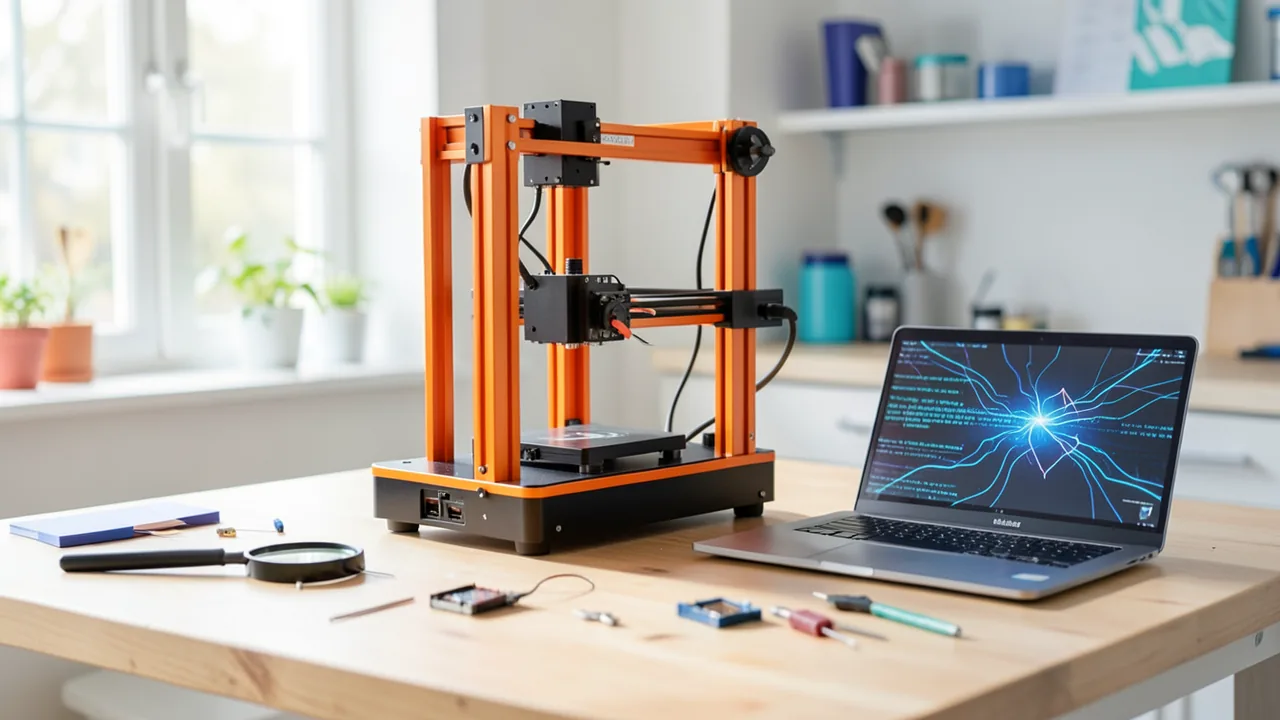
Software developer Yannick Dixken spent a week hacking his own 3D printer, a Prusa MK4S made by Czech manufacturer Prusa Research. He had help from Anthropic's AI model Claude Opus 4.8 and a so-called fuzzer. By the end, in his own words, he had "14 findings, around 23 individual bugs, and a chain that ends with the printer's main controller running code I sent it over the network." As proof, the printer played Rick Astley's "Never Gonna Give You Up" on its display. That's a rickroll, the internet's most famous prank.
Dixken published his results in a blog post titled "Never gonna print you up!", coordinated with Prusa. Tom's Hardware and Ukrainian tech site dev.ua were among those who covered it. The good news first: according to Tom's Hardware, every flaw is fixed as long as your printer runs Buddy firmware 7.0.0 or later.
Who's behind it and how he did it
According to Tom's Hardware, Dixken works as a freelance cloud architect and DevOps and platform engineer. He says security research is just a hobby for him. Over his week, he combined three classic techniques:
- Reverse engineering: You take finished software apart to understand how it works internally, much like opening up a device to trace its circuitry.
- Debugging: You follow step by step what a program is doing to hunt down bugs.
- Fuzzing: A tool automatically bombards the software with huge numbers of random or deliberately broken inputs and watches for crashes or odd behavior. Every crash hints at a possible vulnerability.
On top of that came Claude Opus 4.8. Dixken writes that he was "armed with Opus 4.8 and a fuzzer." The reports don't say exactly what the AI did, such as analyzing code, interpreting crashes, or writing the exploit. Tom's Hardware notes that the original blog post covers the methods in detail.
The vulnerabilities
The most dangerous is a remote code execution (RCE) flaw, which lets an attacker run arbitrary commands on someone else's device from afar. It received a CVSS score of 8.1, officially rated "high." CVSS is a 0-to-10 scale experts use to rate how dangerous a vulnerability is. The flaw was in Prusa Connect, Prusa's printer management platform, which comes as a cloud service and as a self-hosted local version. Through it, Dixken could send his own instructions over the network straight to the printer's main controller.
Other findings include:
| Type of flaw | In a nutshell |
|---|---|
| Attack via USB file names | A crafted file name on a USB stick triggers faulty behavior |
| Heap overflows from tampered encrypted print files | Broken files write past their allotted memory region |
| Network denial of service | The printer can be knocked offline remotely |
A heap overflow happens when a program writes more data into a memory region than it can hold. Like an overflowing glass, the excess spills where it doesn't belong, and attackers can sometimes exploit that to run their own code.
According to Tom's Hardware and dev.ua, many of the bugs likely stem from the original firmware developers relying heavily on assert statements. These are checks in the code along the lines of "X must be true here, otherwise abort." They're handy for catching bugs during development. As the only line of defense against deliberately manipulated input, though, they fall short: an attacker can violate those conditions on purpose and crash the device, or worse.
How Prusa responded
Dixken explicitly praises the manufacturer. Within 24 hours of him sharing his rickroll video on social media, the Prusa team reached out and, according to Dixken, coordinated next steps "professionally, efficiently and kindly." Tom's Hardware points out that companies don't always react this well when someone reports vulnerabilities to them. The release followed coordinated disclosure (responsible disclosure): the researcher notifies the vendor first and only goes public once updates are available.
Prusa has fixed all the reported flaws. If you use a Prusa printer with Buddy firmware, such as the MK4S, update to version 7.0.0 or later. That goes double if your printer is on the network or managed through Prusa Connect.
The bigger picture
This story is a small-scale example of a trend the security industry talks about a lot: AI models are lowering the bar for deep security research. A hobbyist found a serious remote-access flaw plus about two dozen other bugs in a single week, in the firmware of a device that normally gets little attention from security researchers. Specialized teams used to need far longer for work like this.
That cuts both ways. Here, everything went by the book: a researcher reports the flaws, the vendor responds quickly, users get an update. But the same tools are available to attackers who won't report what they find. Connected devices like 3D printers, routers, and smart home gear in particular often rarely get updates and sit unnoticed on home networks for years. For manufacturers, the lesson is clear: code that leans on assert checks instead of properly validating input will get exposed faster from now on.
What remains unclear is how much Claude actually contributed. Fuzzing and reverse engineering have been established methods for years, and as a cloud and DevOps professional, Dixken brings plenty of experience. The reports therefore credit the findings to the combination of human, AI, and classic tooling, not to the AI alone. For Prusa owners, one thing matters most: update your firmware.
Sources
- Merkliste: dev.ua dev.ua
- hackaday.com hackaday.com
- tomshardware.com tomshardware.com
Ask the AI assistant
Questions about this article, installation or background? Our assistant knows this page and runs on our own machine, not in someone else's cloud.
The Assistant is an AI (Gemma 4) and can make mistakes – please check important details against the source. Questions are used only to generate an answer and are deleted after one hour. Please don't enter any personal data.



Comments
What do you think? Already tried it? Write it here, no sign-up needed.
Comments are public. Links aren't allowed, and we delete abusive posts. You can delete your own comment at any time in this browser. Learn more in the Privacy Policy.