
Nvidia CEO caught in spy scandal: did $7.5 billion in AI chips reach China?
Jensen Huang has admitted to cheating on his wife. US authorities believe the woman he had the affair with is a Chinese spy. According to a report by The Information, her network of companies allegedly funneled at least $7.5 billion worth of coveted AI chips into China. The FBI is now involved, and Washington is scrutinizing Nvidia's China business.
What's going on
Nvidia is facing a crisis of a kind rarely seen at a tech company this size. No company supplies more chips for AI systems. On Sunday, CEO Jensen Huang wrote to employees that he had been unfaithful to his wife. He didn't give details. By then, though, several outlets had already linked him to Alice Huang, a senior executive at Megaspeed, a Singapore-based data center operator. The two aren't related despite sharing a surname. US authorities consider her a Chinese intelligence asset. After Huang's admission, Nvidia's board ordered an investigation into whether the 63-year-old had been the target of a foreign espionage operation.
On Tuesday, things got more serious. Citing two people who know Alice Huang, tech outlet The Information reported that the relationship paved the way for at least $7.5 billion worth of Nvidia chips to reach Chinese companies. At a White House press conference, President Donald Trump said he had spoken with Huang and that the FBI was handling the case.
The alleged network behind the chip shipments
According to The Information, Alice Huang, together with her husband and her sister, built a network of companies in Singapore and China to get hold of Nvidia chips. For AI developers, these chips are worth their weight in gold. At the center is Shanghai Century Litong, a company reportedly tied to the sister. It was founded in June 2023. Just four months later, in October, Nvidia granted it preferred cloud partner status. Such partners get priority when scarce AI chips are allocated.
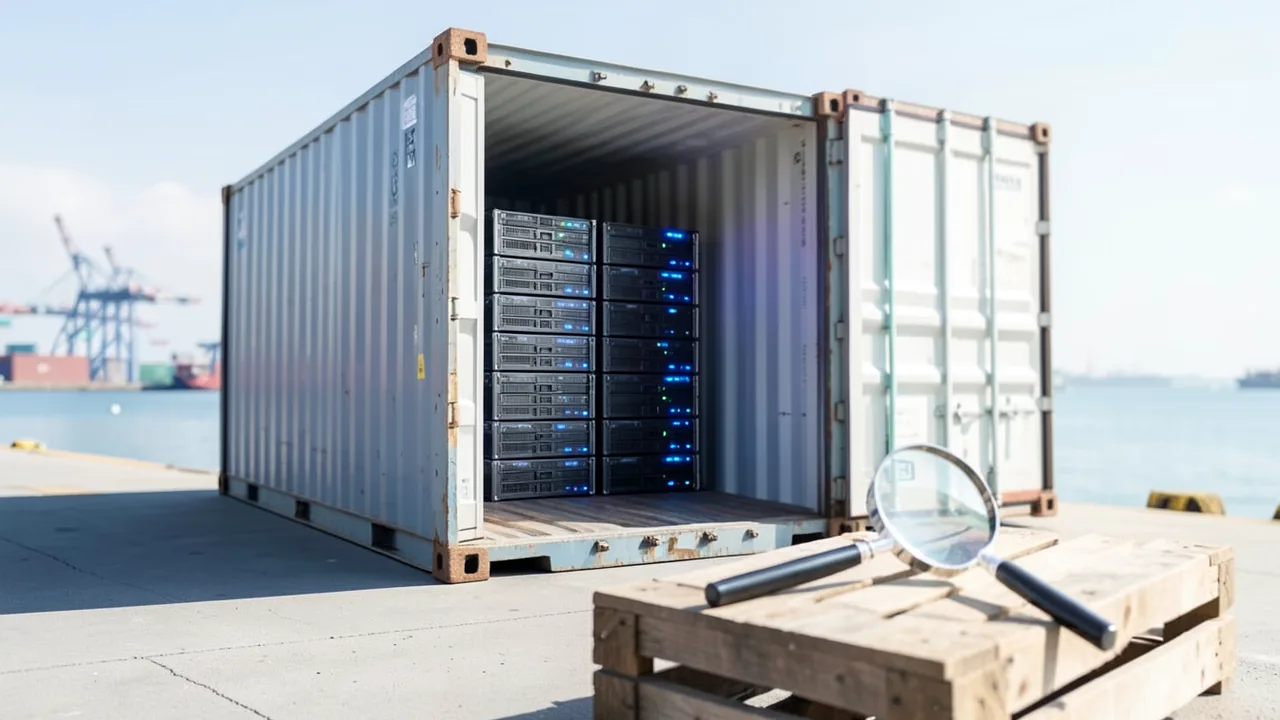
When orders for chips covered by US export restrictions stalled, Alice Huang allegedly used her contacts at Nvidia and its distributors. Around 240,000 AI chips reportedly made it into China this way. According to a Reuters report picked up by The Hindu BusinessLine and the Economic Times, among others, they were mostly H100s and H200s, plus some A100s – Nvidia's high-performance processors for training and running large AI models. Some reportedly ended up at Chinese tech giants Alibaba and Tencent, others at smaller AI labs.
Megaspeed itself allegedly operated in two ways, Digital Trends reports. It rented out computing power in data centers in Southeast Asia to Chinese customers, and in some cases shipped the hardware directly to China. Neither Nvidia nor US authorities have officially confirmed these details. Megaspeed denies any wrongdoing and says inspections found no violations. Alibaba, Tencent and Shanghai Century Litong could not initially be reached by Reuters.
The sources differ on details. News site LavX summarizes The Information's report as "more than $7 billion" and writes that it doesn't allege any legal violation. Other outlets such as Reuters and Digital Trends cite $7.5 billion and frame the case far more sharply.
What authorities know and who's investigating
According to CNBC, the New York Times was first to report that Alice Huang allegedly spied for China's Ministry of State Security. The paper cites people briefed on an intelligence memo that circulated within the Trump administration in the spring. According to the Times, Huang was added at the last minute to the list of tech executives who accompanied Trump to China in May – by which point the president had already been briefed on the intelligence concerns. China calls the allegation slander.
Trump now says he was "amazed" by the allegations. Huang told him he had "no idea" she was a spy. Separately, investigators are examining whether Megaspeed helped China evade export controls. That probe was initially handled by the Commerce Department. According to the New York Times, it was abruptly handed to the Justice Department after Nvidia's general counsel emailed the Commerce Department asking for information about the investigation.
The political landscape has shifted too. In last week's midterm elections, Democrats won decisively and will soon take control of both the House and the Senate. Three House committees want to question Huang about Megaspeed in closed-door sessions. Democratic lawmakers are announcing their own congressional investigations.
Four years of fighting over the Chinese market
To put the case in context, it helps to look back. In October 2022, the Biden administration introduced sweeping export controls – government rules that ban the sale of certain technology abroad or require a license for it. Since then, Nvidia has no longer been able to sell its most powerful chips freely to China. Before that, China accounted for nearly a quarter of its revenue. Nvidia responded by designing cut-down versions for the Chinese market. After further tightening came the H20. The Trump administration then restricted that chip too, following reports that Chinese model developer DeepSeek was using banned Nvidia chips. Nvidia says the canceled H20 orders cost it $5.5 billion.
In October 2025, Huang said: "We are 100 percent out of China." After that, things loosened up again. In December, Trump allowed H200 exports to China, provided the US receives 25 percent of the sales revenue. Huang is seen as a close Trump confidant, advised the White House on AI rules and at the same time lobbied for looser export restrictions. Patrick Moorhead, CEO of analyst firm Moor Insights & Strategy, told CNBC:
"In 35 years, I have not seen a chip CEO with this much direct influence on export policy."
How big is Nvidia's China share really?
Officially, it's small. Nvidia says about 9 percent of revenue in the last fiscal year came from China including Hong Kong, and 8 percent in the most recent quarter. But that also includes segments like gaming, automotive and industrial. According to Nvidia, H200 shipments to China accounted for less than 1 percent of data center revenue in the quarter through July. One reason, Moorhead says, is that Beijing hasn't yet approved large imports, even though the US has licensed sales to Alibaba, Tencent, ByteDance and others.
Critics doubt these figures. In May, short seller Culper Research, which bets on falling stock prices, claimed that more than 20 percent of Nvidia's compute revenue in fiscal 2026 came from China, made possible by "illegal diversion of GPUs and intermediaries in Southeast Asia". In December 2025, Bloomberg reported that Megaspeed had imported 50,000 more Nvidia chips than Nvidia had counted in its data centers. There's also a legal loophole: Chinese companies may rent computing power on Nvidia GPUs, for example from cloud providers in Europe, even if they can't buy the chips themselves. Adding to the suspicion, Nvidia changed its regional reporting in 2025. Revenue is now booked by the customer's headquarters location rather than the billing location, and Singapore is no longer broken out separately.
Reactions on Wall Street and in Beijing
On Monday, Nvidia shares closed down more than 4 percent. Nvidia says its board has no reason to believe that national security or "Nvidia secrets" were compromised. The company hasn't yet commented on The Information's allegations. China's Foreign Ministry calls the espionage allegations baseless.
Our take
This case is about more than an executive's private life. At its core is the question of whether US export controls on AI chips actually work in practice. If a personal network really managed to get hundreds of thousands of restricted chips into China, it would be a heavy blow to Washington's strategy of slowing China's AI development. It would also be embarrassing for US policymakers that Huang, of all people, had so much influence over that policy.
But a lot remains unclear. The Information's figures rest on two anonymous sources. Nvidia and the authorities haven't confirmed them, and it's also unclear whether Huang knew about the alleged intelligence ties. The political fallout, however, is predictable. Moorhead expects new legislation that could, for example, give Congress oversight of export licenses or require chipmakers to track the location of their chips via a security mechanism. "Every China license will now be read in light of this story," he says. "Jensen was Nvidia's most important voice on China, and that voice has been weakened."
Related videos
Sources
- Merkliste: digitaltrends.com digitaltrends.com
- Merkliste: news.lavx.hu news.lavx.hu
- thehindubusinessline.com thehindubusinessline.com
- economictimes.indiatimes.com economictimes.indiatimes.com
- cnbc.com cnbc.com
- Merkliste: epochtimes.com epochtimes.com
- Google News (DE) news.google.com
- Golem (DE, alles) golem.de
- Merkliste: tomshardware.com tomshardware.com
- Reddit r/singularity reuters.com
- Lemmy: Technology lemmy.world
- Merkliste: biz.heraldcorp.com biz.heraldcorp.com
- Merkliste: headtopics.com us.headtopics.com
Ask the AI assistant
Questions about this article, installation or background? Our assistant knows this page and runs on our own machine, not in someone else's cloud.
The Assistant is an AI (Gemma 4) and can make mistakes – please check important details against the source. Questions are used only to generate an answer and are deleted after one hour. Please don't enter any personal data.



Comments
What do you think? Already tried it? Write it here, no sign-up needed.
Comments are public. Links aren't allowed, and we delete abusive posts. You can delete your own comment at any time in this browser. Learn more in the Privacy Policy.