
Light-powered AI: Q.ANT's language model only runs because real attention is gone
Stuttgart startup Q.ANT says it has run a language model “with light” for the first time. It hasn't published a single number to back that up. We looked at what the photonic chip actually computes and what pilot operator LRZ has measured. We also checked the promises from Q.ANT, Lightmatter and Lumai against the evidence.
What's going on
“A language model run on light for the first time”: that's how Stuttgart photonics startup Q.ANT introduced its new NPU Gen 2+ chip at the SC26 supercomputing conference in Chicago on November 17, 2026. The timing is good. Two days later, the International Energy Agency (IEA) projected that data centers could use twice as much electricity by 2030 as they do today, with AI responsible for three quarters of the increase. According to The Guardian, the industry's CO₂ emissions could rise by 70 percent. A promise that light will make AI more efficient couldn't land at a better moment.
Read the announcement closely, though, and the most important part is missing. There's no performance data, no whole-system power figure, no comparison with a purely electronic run, and not even the name of the model. French trade site Pause Hardware reached the same conclusion: the demo shows that hybrid operation works, not that it pays off. We looked at what the chip actually does. Our thesis: the demo doesn't run because light can compute a language model's attention. It runs because Q.ANT replaced that attention with an operation that happens to suit optics particularly well.
What the chip really does in the demo
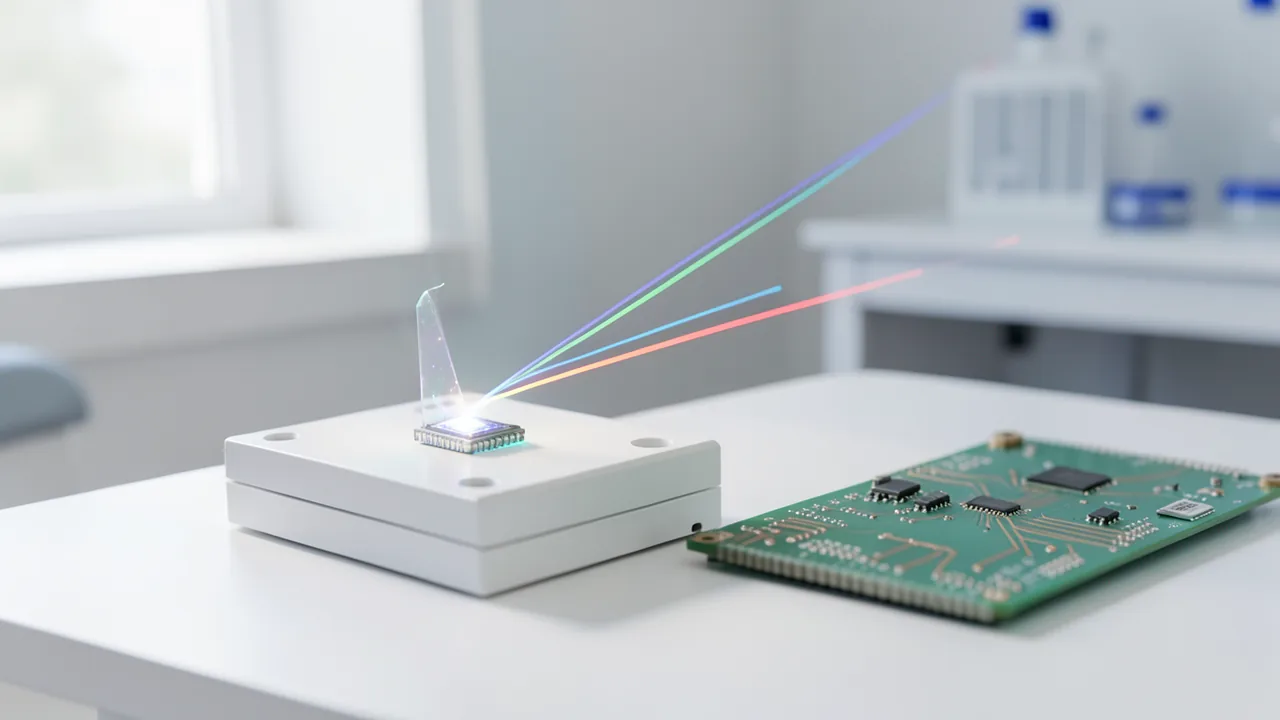
What's new in Gen 2+ is the discrete Fourier transform (DFT). It breaks a signal down into its frequency components, much like a prism splits white light into colors. Electronic processors need a chain of computational steps for this. Q.ANT says its chip does it in a single pass of light. In the demo, the NPU worked as a co-processor next to an AMD GPU, whose model Q.ANT doesn't name. According to the announcement, the optical Fourier functions replaced “a compute-intensive attention layer.”
Attention is the heart of today's language models. For every word, the model calculates how much it should pay attention to every other word in the text, and that weighting depends on the content. A Fourier transform does something different: it mixes all positions according to a fixed pattern that never changes and hasn't learned anything.
The idea isn't new. Google published it in 2021 as FNet, which replaced self-attention in Transformer encoders with a Fourier transform that has no trainable parameters. The result: about 80 percent faster training on GPUs, but only 92 to 97 percent of BERT's accuracy on the GLUE language-understanding benchmark. FNet only worked for encoders, meaning models that read a text as a whole. Chatbots, by contrast, generate text word by word and aren't allowed to look ahead. A follow-up paper called FNetAR adapted the idea for that setting: replacing half the attention layers raised perplexity on WikiText-103 from 24.2 to 25.8. Perplexity measures how “surprised” a model is by the next word; lower is better. We aren't aware of any widely used mid-sized language model that fully replaces attention with Fourier mixing. FFT methods show up at most in niche architectures, such as the Hyena family that the biology model Evo 2 builds on. Even there, a few real attention layers remain.
Our take: This is the crux of the matter. According to a recent survey from the University of Texas, photonics is best suited to matrices that rarely change, such as trained weights that stay the same across many inputs. Real attention is the opposite: both factors of the computation are generated fresh at runtime, for every token. That puts the load squarely on conversion and reprogramming, exactly where optics is weak. A DFT, on the other hand, is a fixed matrix, the ideal case for a light-based chip. So what the demo mainly shows is that you can rebuild a language model to fit the chip. How much quality that rebuild costs, Q.ANT doesn't say.
What the pilot operators measured
The most solid numbers come from the Leibniz Supercomputing Centre (LRZ) in Garching, which has been running Q.ANT chips since 2025. A technical report from November 11, 2026 by five authors led by Josef Weidendorfer confirms clear progress from Generation 1 to Generation 2. The key sentence, however, is in the abstract: analog noise limits effective precision to about 6 to 7 bits. In 2025, according to The Quantum Insider, Q.ANT was still advertising “16-bit floating-point precision with 99.7 percent accuracy for all operations.” LRZ also cites 16 bits in a report from April, but for the conversion between digital and analog data. How finely the converters work and how accurate the final result is are two separate questions.
The report names digital-analog conversion, data transport, electronic processing and weak compiler support as bottlenecks. More figures from the April report:
- Gen 2 manages 500 million operations per second per optical channel, so roughly 4 billion per second across eight channels. The clock rate is 2 GHz.
- Server and card together draw 350 to 420 watts, the card alone 25 to 100 watts.
- Tests covered matrix computations, image recognition and small neural networks such as MNIST. Large language models weren't included.
- Not everything runs optically. The cards need their own electronics and constantly exchange data with conventional processors.
For comparison: according to Physics World, Lightmatter's processor from its Nature paper reaches 65.5 trillion operations per second at 78 watts. That works out to roughly 16,000 times the 4 billion of Gen 2. There's no standard for how the two companies count an “operation,” but the order of magnitude makes it clear that Q.ANT's hardware is still operating at research scale.
Vendor claims vs. evidence
| Vendor | Claim | What's backed up |
|---|---|---|
| Q.ANT | “up to 30x less energy, 50x more performance” (Gen 2 launch, Nov. 2025) | LRZ: more than 50x faster at matrix multiplication and 6x less card energy, both compared with Q.ANT's own Gen 1, not with GPUs |
| Q.ANT | 16-bit floating point, 99.7% accuracy | LRZ report: effectively about 6–7 bits due to analog noise |
| Q.ANT | Language model run on light (Gen 2+) | no figures on speed, power or quality; model unknown |
| Lightmatter | ResNet and BERT at “near FP32 accuracy” without retraining | Nature paper (2025); according to heise, physicist Mario Chemnitz criticizes that the system isn't fully disclosed |
| Lumai | “up to 90% less energy” | no independent measurement; UK funding agency ARIA has yet to test the technology |
One correction for the record: a line from the Lightmatter blog about an efficiency gain of “only 2x” gets quoted a lot. But there it refers to carbon nanotube processors, not photonics. On photonics, Lightmatter says something different and at least as sobering: energy requirements grow “exponentially” with the required precision. And so far, no photonic chip has reached the precision needed for practical AI applications.
Lumai's numbers contain an inconsistency. “Up to 90 percent less power” equals a factor of 10. But on its own blog, Lumai explicitly gives that factor as “energy per inference” compared with silicon, without a test setup or reference device. To its credit, Lumai computes in INT4 and INT8, openly embracing low precision, and targets a task that suits optics well: prefill. That's the phase in which the model reads the entire input at once, mostly running large matrix multiplications.
The real bottleneck: translating between light and electricity
Light computes fast, but it can't store anything. Every number has to be translated into a light signal and then digitized again. That's the job of digital-to-analog and analog-to-digital converters (DACs and ADCs). According to the survey, in the authors' simulations it's exactly this electro-optical conversion that accounts for most of the energy consumption, ahead of lasers and data transport. Converter overhead grows exponentially with bit count; the authors call it a “precision wall.”
According to HPCwire, Lumai's head of product explains why larger matrices help: conversion costs scale with a vector's width, while compute scales with its square. So optics pays off for large, fixed matrix operations that stay on the chip for a long time. LRZ reaches the same conclusion: it's most efficient to stay in the optical domain as long as possible. In Q.ANT's demo, data moves back and forth between the NPU and GPU, at least at the replaced layer. What that costs in energy is anyone's guess.
Right now, photonics is gaining ground mainly in networking, not in computing. Lightmatter now puts its Passage line of optical interconnects front and center. An arXiv paper from September 2026 simulates how optical links between GPUs could speed up prefill for large Mixture-of-Experts models by a factor of 2.1 to 5.8. Mixture-of-Experts models activate only some of their subnetworks for each word. In this approach, light moves the data while the computing remains electronic and digital.
What you can try yourself
In September 2026, Q.ANT released an open-source SDK on GitHub (Apache-2.0, Python and C/C++). With a CPU backend, it runs without special hardware, including on Windows and macOS. Support for Gen 2+ and Fourier functions is supposed to follow. Real hardware is available in the free pilot with IONOS, but only for selected applicants with a concrete use case. What's on offer there is the second generation, not the new Fourier chip. Q.ANT has announced commercial Gen 2 and Gen 2+ systems for the second half of 2027.
The bigger picture
Q.ANT is one of the few European companies that actually ships photonic computing chips and lets independent data centers put them to the test. That's more than many competitors can claim. The LRZ report is honest and encouraging, but it describes a technology for tasks that can get by with low precision: image recognition, preprocessing, small networks.
Our take: The language model demo is above all a software bet. Q.ANT is betting that developers will rebuild their models around operations that light handles naturally. Software chief Utz Bacher says as much himself: photonics gives developers the chance “to rethink the math behind their applications.” That could work out; hybrid models with only a few attention layers do exist. But FNet hasn't passed the stress test of the past five years: the big language models still rely on real attention. Whether Q.ANT's approach holds up comes down to three numbers that are still missing: the quality of the rebuilt model, the watts per token for the whole system including GPU and converters, and the speed compared with the same computation on the GPU alone. Until those numbers are out, “a language model run on light” only proves that a model can be rebuilt to run on the chip. As things stand, there's no evidence it saves power.
Sources
- Pause Hardware: Q.ANT NPU photonique et LLM pausehardware.com
- The Quantum Insider: Q.ANT Demonstrates Hybrid Photonic-GPU System for Language Models thequantuminsider.com
- Pressemitteilung NPU Gen 2+ (Manila Times / GlobeNewswire) manilatimes.net
- Jon Peddie Research: Q.ANT brings Fourier transforms into light jonpeddie.com
- Q.ANT Website qant.com
- LRZ-Technikbericht: A System-Level Evaluation of Q.ANT Native Processing Units (Zenodo) zenodo.org
- LRZ: Photonic Computers in Real-World Test lrz.de
- Photonics Online: Q.ANT deploys Gen 2 at LRZ photonicsonline.com
- Photonics Online: Q.ANT unveils second-generation photonic processor photonicsonline.com
- The Quantum Insider: Q.ANT at ISC 2025 (16-Bit-Angabe) thequantuminsider.com
- GitHub: Q-ANT-GmbH/qant_native_computing_toolkit github.com
- IONOS Newsroom: IONOS and Q.ANT launch photonic computing pilot ionos.com
- arXiv: FNet – Mixing Tokens with Fourier Transforms arxiv.org
- arXiv: FNetAR arxiv.org
- arXiv: Convolutional Multi-Hybrid Language Models at Scale (StripedHyena 2 / Evo 2) arxiv.org
- arXiv: Harnessing Photonics for Machine Intelligence arxiv.org
- arXiv: Scaling Inference Prefill with High-Radix Photonic Interconnects arxiv.org
- Lightmatter Blog: A New Kind of Computer lightmatter.co
- Physics World: Photonic chips perform as well as electronic counterparts physicsworld.com
- heise: Erste Lichtprozessoren betreiben KI effizient heise.de
- Lumai Blog: Your inference stack is optimized on one side lumai.ai
- The Guardian: Datacentres to create 70% more carbon emissions by 2030 theguardian.com
- Irish Examiner: AI datacentres set to drive 70% rise in carbon emissions irishexaminer.com
Ask the AI assistant
Questions about this article, installation or background? Our assistant knows this page and runs on our own machine, not in someone else's cloud.
The Assistant is an AI (Gemma 4) and can make mistakes – please check important details against the source. Questions are used only to generate an answer and are deleted after one hour. Please don't enter any personal data.



Comments
What do you think? Already tried it? Write it here, no sign-up needed.
Comments are public. Links aren't allowed, and we delete abusive posts. You can delete your own comment at any time in this browser. Learn more in the Privacy Policy.