
No coding skills: man says he built a huge open-world RPG with Claude in 4 days
An American with no programming experience says he used Anthropic's AI models to build a role-playing game with a 144-square-kilometer world in just four days. He says the code, 3D models, voices and music all came from AI tools. Nobody has independently verified his claims, though.
What's going on
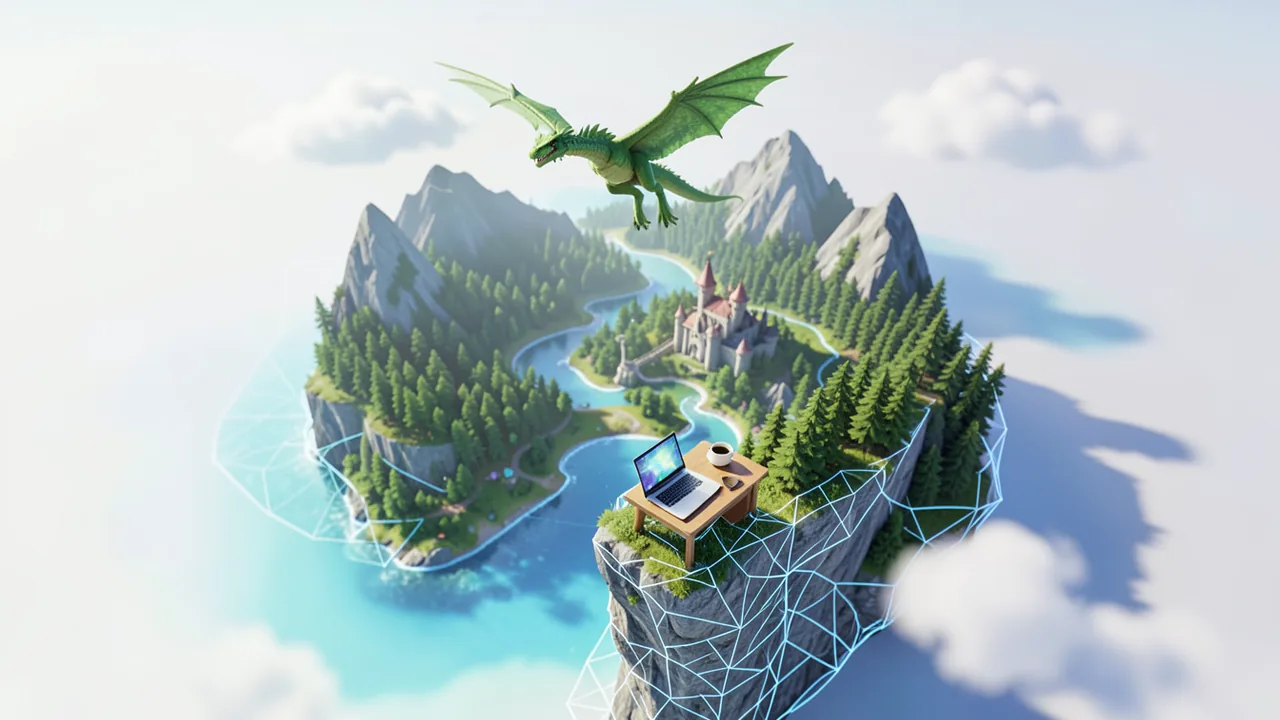
An American named Mike Houser (spelled "Hauser" in some reports) is making waves in the games industry. He posted a demo video on his X account of "Age of Dragon" (sometimes called "Age of Dragons"), an open-world RPG he built himself. The twist: Houser says he can't code at all. He claims he built the game in just four days by directing Anthropic's AI models. The video has now passed 300,000 views.
The story was covered by the finance site BigGo Finance and the South Korean business paper Seoul Economic Daily, which in turn cites the tech news site Explainex. Both outlets point out that every number comes from Houser himself and none of it has been independently verified. As far as anyone can tell, you can't play the game yet. All there is so far is the video.
"I can't code, but I built this game from scratch with AI in just a few days,"
Houser says. His job, he explains, was to give the AI direction and review what it produced.
The game world by the numbers
In open-world games, you roam freely through a large virtual world and take on tasks along the way. Well-known examples include "Skyrim" and "Zelda: Breath of the Wild". Games like these need huge maps and complex systems. They're usually built by teams of dozens or hundreds of developers over several years, on big budgets.
Houser says his world is a 12-by-12-kilometer island. It takes about 45 minutes to cross on foot, or around four minutes on a dragon flying at 180 km/h. He claims the world is twice the size of the one in Bethesda's "The Elder Scrolls V: Skyrim".
| Feature | Figure (according to Houser) |
|---|---|
| Development time | 4 days |
| World size | 144 km² (12 × 12 km) |
| Regions / locations / dungeons | 6 / 79 / 9 |
| Quests | 34 |
| Enemies | 56 regular enemy types, 20 bosses |
| Generated code | approx. 80,000 lines |
| Tokens used | more than 21 billion |
| 3D models | more than 400 |
| Audio | 544 voice lines, 772 sound effects, 37 music tracks |
| AI models used | Claude Fable 5.2, Claude Opus 5.5 |
How the game was made
Houser relied on vibe coding. You describe what you want to the AI in plain language and let it write the code, without programming anything line by line yourself. Anthropic's Claude Fable 5.2 and Claude Opus 5.5 wrote the code.
The visuals came from AI too. Houser first had illustrations and concept art generated for the key locations and characters. He then fed these into Tripo, an AI tool that turns images into 3D models. That gave him more than 400 assets, meaning the individual building blocks of a game, such as characters, buildings and items.
The animation work stands out most, since animation is known as one of the most labor-intensive parts of game development. Houser set up a shared skeleton for the characters and tuned their movements and speed to match each character's weight. Claude handled the rigging through the free 3D program Blender. Rigging means fitting a 3D model with a virtual skeleton so it can move.
"Telling a large language model 'Create a 3D model with Blender' – that fundamentally changes game development,"
Houser says. For audio, he used tools from the voice AI company ElevenLabs: 544 character voice lines, 772 sound effects and 37 music tracks.
21 billion tokens: what that means
The number that jumps out most is the more than 21 billion tokens. Tokens are the small chunks of text and code that AI models use to process language, roughly a word fragment or a few characters each. According to Seoul Economic Daily, Explainex points out that a single AI running around the clock could hardly get through that many tokens in such a short time. The site suspects that several AI agents worked in parallel. These are AI programs that carry out multiple steps on their own: writing code, launching the game, finding bugs, fixing them, and repeating the cycle over and over.
It also shows that "no coding skills" doesn't mean "no effort". The sources don't say how much all those tokens cost. At the usual prices for top-tier models, though, a project like this is unlikely to have been cheap. There are no exact numbers, and it's also unclear whether Houser was on a flat-rate subscription.
Industry skepticism
For all the excitement, both reports are cautious. Being able to build a big game with AI is a long way from making a commercial hit. A video alone can't tell you how well the game controls, how stable it is or whether bugs show up over longer play sessions. BigGo Finance quotes an industry insider:
"Today, AI makes it possible to produce a large amount of game content in a short time. Reaching the polish and stability that commercial games need is another matter."
The Skyrim comparison doesn't hold up well either. Size alone says little about quality. Big studios build their worlds by hand and pack them with detail, stories and balanced game mechanics. Spread 34 quests and 79 locations across 144 square kilometers and you get a lot of empty space on average.
The bigger picture
The case shows how well AI tools can now work together. A language model writes code and drives Blender, while specialized AI services like Tripo and ElevenLabs supply 3D models and sound. For hobbyists and small indie teams, that lowers the barrier to entry dramatically. The question is no longer just "Can I code?" More and more, it's "Can I describe what I want clearly and judge the results?"
There are still caveats. Every figure, from the four days to the 80,000 lines and 21 billion tokens, is self-reported, and nobody has verified any of it. The game apparently isn't publicly playable, and there are no independent tests. Even the spelling of Houser's name and the game's title differs between reports. And the huge token count points to serious compute costs that most hobbyists can't easily cover. It's an open question whether "Age of Dragon" becomes a real, finished game or stays an impressive tech demo.
Sources
- Google News (US) finance.biggo.com
- en.sedaily.com en.sedaily.com
Ask the AI assistant
Questions about this article, installation or background? Our assistant knows this page and runs on our own machine, not in someone else's cloud.
The Assistant is an AI (Gemma 4) and can make mistakes – please check important details against the source. Questions are used only to generate an answer and are deleted after one hour. Please don't enter any personal data.



Comments
What do you think? Already tried it? Write it here, no sign-up needed.
Comments are public. Links aren't allowed, and we delete abusive posts. You can delete your own comment at any time in this browser. Learn more in the Privacy Policy.