
World Labs opens up Atlas: turn a sketch or a sentence into a 3D world you can explore
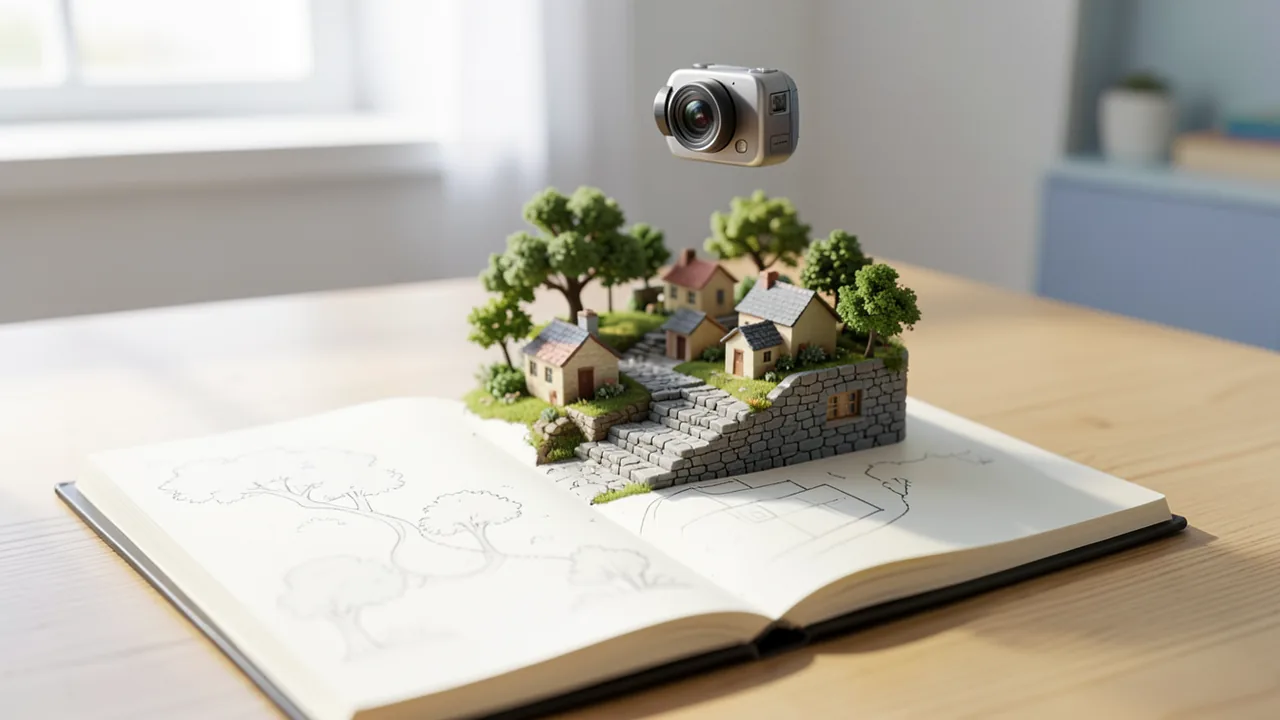
AI researcher Fei-Fei Li's startup is making its world model Atlas available to everyone, via a web app and a developer API, with 10,000 free credits to start. A photo, a doodle or a single sentence becomes a 3D scene you can move the camera through freely and export all the way to Blender or a game engine.
What's happening
World Labs, the AI startup founded by Stanford researcher Fei-Fei Li, has opened up its world model Atlas to everyone. Since November 13, 2026, anyone can sign up at atlas.worldlabs.ai. At launch, there's a web app and an API for developers. New accounts get 10,000 credits. World Labs first unveiled Atlas on September 1, 2026, when only select enterprise partners could use it. Until recently, the Viewfinder web app was also still a closed beta with a waitlist, as Unite.ai reported.
A world model is an AI that doesn't just paint spatial scenes as flat images. It represents a space that's internally consistent. You can move the camera through it, generate views of spots that never appeared in any photo and reuse the result as 3D data. Fei-Fei Li commented on the launch on X:
"Atlas is now available to everyone!! I can't wait to see what people will build with our latest world model!"
According to the Chinese platform smzdm, Martin Casado, a partner at investor a16z, called the launch the biggest step in 3D generation and reconstruction since the rise of generative AI. a16z isn't a neutral party, so take the praise with a grain of salt.
How Atlas works
World Labs describes Atlas as an "omni model". It was trained from scratch and processes text, images, video and 3D data natively. The architecture is a multimodal autoregressive diffusion transformer. The model generates one frame after another, and each new element takes into account everything that came before. Each element is created through diffusion, meaning it's gradually worked out of noise.
What World Labs highlights is spatial context. A language model remembers text. Atlas, by contrast, anchors every input image to a specific position in 3D space, and every generated image is tied to an exact camera position. That's why you can steer the camera with "pixel precision" instead of directing it with vague text commands like "camera pans left". SiliconANGLE sees this as the key difference from older video generators like Sora.
Capabilities, according to the company:
- Camera-guided generation: up to one minute of 1440p video from one or a few images.
- Reconstruction: World Labs says real places can often be faithfully recreated from just two or three photos. But Atlas can also handle more than a hundred images. The more the model sees, the less it has to make up.
- 3D output: point clouds and Gaussian splats, which build a scene from millions of tiny, colored, semi-transparent blobs that can be rendered quickly from any angle.
- Space-time simulation: footage from three to five smartphones becomes a "bullet time" effect, a frozen moment the camera circles around. For robotics, Atlas can generate simulated camera and depth data from a robot's point of view.
- Image generation: including 360-degree panoramas from text.
In a blind study where human raters judged how closely a given camera path was followed, Atlas scored well ahead of Gemini Omni Flash and FLUX, according to SiliconANGLE. For 3D reconstruction from a few images, it's said to beat several open-source models. Both claims come from World Labs. There are no independent measurements yet.
Four tools: from photo to game asset
The home page offers four tools that together form a production pipeline:
- Viewfinder: turns an image into a scene. You upload a JPG, PNG, WEBP or HEIC image, move a virtual camera and render new angles. Output comes as MP4 videos or Gaussian splats (PLY/SPZ). For reconstructing real places, you can use up to 64 input images.
- Chisel: builds 3D environments with an AI agent. You can feed it images, documents, URLs or 3D models (GLB/glTF/OBJ/FBX) as references. You describe in plain language what you want, and the agent builds a graybox, a rough scaffold of simple shapes with no textures. Atlas then renders that scaffold into finished images. The idea: first you decide where walls and furniture go, then style, materials and lighting come on top.
- Relight: relights a splat scene and adds shadows.
- Splat to mesh: converts splats into a textured mesh, a classic 3D model made of triangles, in GLB format that you can load into game engines.
There's also a Blender integration and hooks into the coding agents Codex and Claude Code.
What it costs
| Action | Credits |
|---|---|
| Starting balance for new accounts | 10,000 |
| Viewfinder: render one new image | 50 |
| Chisel: render all camera positions for one variant | 160 |
| Chisel agent (Gemini 4 Argon), per 1M output tokens | 10,000 |
| Generate a full Gaussian splat scene | 5,000 |
So the starting balance is enough to get to know the tools. Build two full splat scenes and it's gone. You'll need a phone number for verification when you sign up. The sources don't mention prices for additional credits.
Hands-on: Chongqing in the rain
The smzdm tester entered a single sentence: an alley in the mountain city of Chongqing during a downpour, with steep stone stairs, tangled old apartment blocks covered in neon signs and clotheslines, wet flagstones with pink and blue reflections, and a monorail running straight through a building. After about a minute, a reference image appeared that contained all of those elements.
Then the Chisel agent took over. It drew up a six-step plan and worked through it in about 30 minutes: blocking out the building masses, placing nine camera positions, building the train and background houses, adding balconies, grilles and corrugated metal roofs, placing 15 neon boxes and clotheslines, and finally checking each camera shot for blocked views. The system found and fixed errors on its own, such as a "bridge pier floating 8.25 meters in the air". The finished scene had 38 stair steps, five houses on each side and a three-car train with pantographs. The "storm on a deep blue night" variant produced twelve finished images for 160 credits, showing details down to the window grilles and T-shirts on the line.
For Viewfinder, the tester has a practical tip: you need to move the camera sideways away from its original position. If you only rotate it in place, you won't get a result, because depth estimation needs parallax, the shift that happens when your viewpoint moves. A new image takes about a minute. From several images, you can generate a full splat scene in around 15 minutes.
Real time and the competition
A week earlier, on November 5, World Labs introduced Frameboy, a research preview. Atlas scenes run on cloud GPUs and stream to your browser at up to 15 frames per second while you control the camera. According to Unite.ai, World Labs admits this requires a powerful cloud server and is expensive compared with local rendering. Frameboy builds on its predecessor RTFM from October 2025, which ran on a single H100 GPU but mostly interpolated between existing viewpoints.
Rivals are already chiming in. Hang Chu of Viggle posted a head-to-head comparison with the company's own model, JST-2. He stresses that JST-2 generates 3D content directly and criticizes Atlas's detour through Gaussian splats as extra work and time. SiliconANGLE also names Odyssey, Yann LeCun's AMI Labs and Niantic Spatial as competitors. According to SiliconANGLE, World Labs has raised $1.2 billion, with backers including Nvidia, AMD and Autodesk.
The bottom line
What's most interesting about this launch isn't the image quality of individual results but the package around it. World Labs offers an end-to-end pipeline with clear pricing: from a photo or a sentence, through planned camera moves and renders, to a 3D file for Blender or a game engine. That fits the coding-agent trend. Code for a game can be generated quickly these days, but environments and graphics have barely been possible. World Labs researcher Ben Mildenhall describes the division of labor like this: agents build the rough geometry, Atlas generates the image. Designer Ian Curtis showed off a walkable first-person world made with Atlas, the coding model Fable 5.2 and three.js.
There are limits, though. An exported scene isn't a game or a film yet: game rules, characters and checking the assets are still manual work. Atlas only runs in the cloud, and the weights aren't openly available. If you build a lot, you'll burn through credits fast, and World Labs itself says real-time exploration is still expensive. So far, all the benchmark wins come from the company itself. Whether Atlas lives up to its demos on complex real-world places is something we'll only find out now that lots of people can use it.
Related videos
Sources
- Merkliste: post.smzdm.com post.smzdm.com
- unite.ai unite.ai
- worldlabs.ai worldlabs.ai
- siliconangle.com siliconangle.com
Ask the AI assistant
Questions about this article, installation or background? Our assistant knows this page and runs on our own machine, not in someone else's cloud.
The Assistant is an AI (Gemma 4) and can make mistakes – please check important details against the source. Questions are used only to generate an answer and are deleted after one hour. Please don't enter any personal data.


Comments
What do you think? Already tried it? Write it here, no sign-up needed.
Comments are public. Links aren't allowed, and we delete abusive posts. You can delete your own comment at any time in this browser. Learn more in the Privacy Policy.