
NVIDIA expands Cosmos with tools to train and test world models
NVIDIA has expanded its Cosmos world-model platform with training tools, simulation checkpoints and five Cosmos Data Factory blueprints. The goal: help developers feed, adapt, test and deploy physical AI such as robots and autonomous vehicles faster.
What's going on
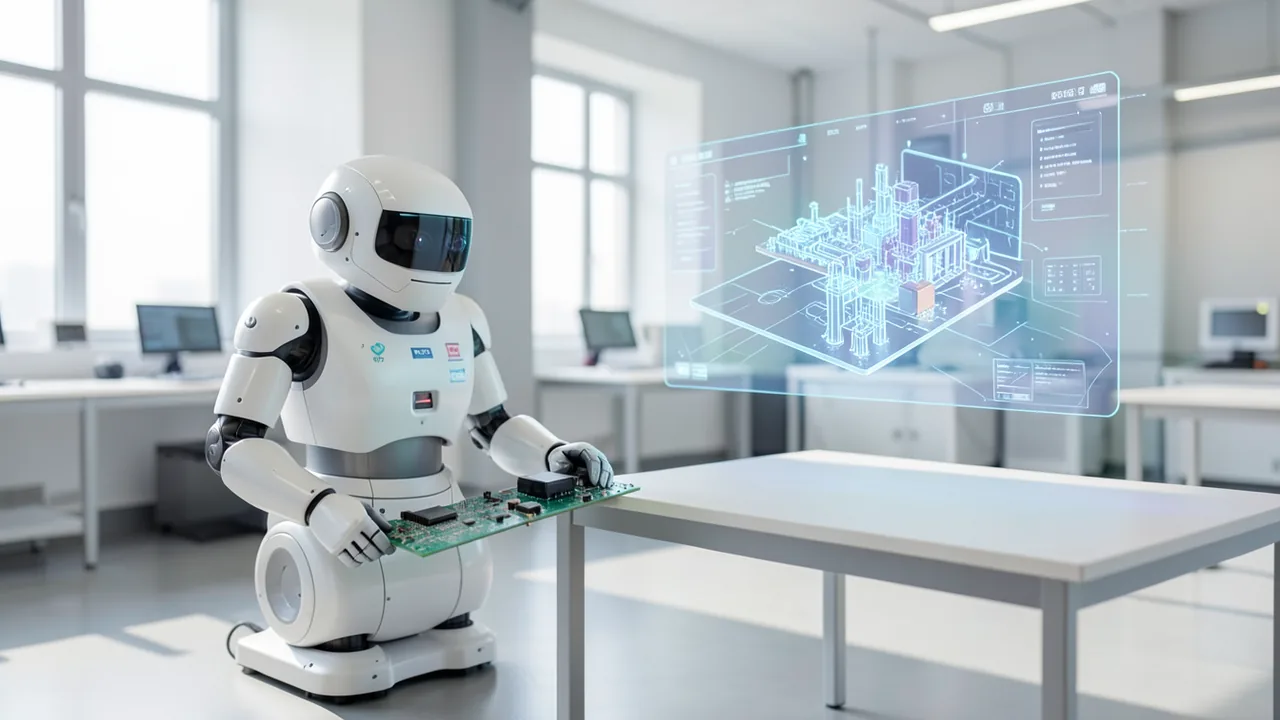
On October 22, 2026, NVIDIA expanded the Cosmos platform, which helps developers build world models. World models are AI systems that understand and simulate the real world. They power "physical AI" such as robots, autonomous vehicles and video analytics systems. The update adds training tools, simulation checkpoints (saved model states) and blueprints (reference templates) for the Cosmos Data Factory. All information comes from NVIDIA; customer examples are vendor claims. NVIDIA calls the platform modular and open, and says its open models rank in the top 5 on six open leaderboards.
Better training data: Cosmos Data Factory
World models need multimodal, multisensor data, such as video combined with other sensors. The Data Factory bundles tools for labeling, curating, augmenting and scoring such data. It works with "agentic skills," meaning capabilities that AI agents can use on their own. Cosmos Curator, a GPU-accelerated tool for curating video datasets, now supports multimodal, multisensor inputs.
The five cloud blueprints (via GitHub, Microsoft Azure, Nebius and CoreWeave):
- Autonomous Vehicle Dataset Generation: curates and labels driving data and adds synthetic examples of scenarios that are hard to capture.
- Image Attribute Augmentation: varies the appearance of objects to improve image search.
- Event Video Generation: turns still images into synthetic videos of rare or dangerous events.
- Defect Image Generation: creates defect images of circuit boards, metal and glass for inspection models.
- Video Data Augmentation: changes weather and lighting in existing footage without altering the scene structure.
Early adopters, according to NVIDIA: Porsche is building a shared data flywheel for Volkswagen Group brands via Voxel51 on Microsoft Azure. It expects up to 90% fewer repeated test drives and up to 85% shorter development cycles. ANYbotics generated more than 1,500 synthetic video clips to teach inspection robots to recognize things like liquid puddles. Ultralytics retrained its YOLO model on real images plus deliberately generated defects, improving localization and recall.
Train, adapt and optimize models
At GTC Berlin, NVIDIA extended the Cosmos framework tools for training, optimization and deployment to more open models as Agent Skills, alongside Cosmos 3. Developers and agents can adapt models such as GR00T, Alpamayo, Qwen, Pi0.5 and other compatible Hugging Face models through fine-tuning and reinforcement learning. They can optimize them with distillation (transferring a large model's knowledge to a small one) and quantization (lower numeric precision for less memory), then deploy them with fast inference.
The research lab MicroAGI post-trained Cosmos 3 on videos of people handling objects. It then distilled its 32-billion-parameter reasoner into a Nano model with 8 billion parameters, with no loss in accuracy, according to NVIDIA. With Roboflow, you can label data and retrain Cosmos 3 for your own environments, then deploy on Roboflow hosting or on local NVIDIA GPUs for factories and warehouses.
Testing and speed
New Cosmos 3 Nano variants for simulation are meant to let you test autonomous policies (control strategies) in repeatable, hard-to-capture scenarios with multiple camera views and sensors. Accompanying code lets you adapt the models to train and evaluate policies for autonomous vehicles and dual-arm robots in interactive simulations before they go into the real world.
NVIDIA says the updated Cosmos 3 NIM microservices (prepackaged inference containers) deliver up to twice the inference speed with no quality loss in validated configurations. Continuous video analysis enables alerts in under a second. The new Metropolis blueprint for video search and summarization (VSS 3.3) builds on the NIMs, turns a prompt into a video AI application, and is meant to support 40% more video streams per GPU. ADNOC uses Fogsphere MistIQ, built with Cosmos and the VSS blueprint, to detect safety risks in real time at 65 sites. Rare events are trained on synthetic data, so nobody has to stage dangerous situations for real.
Our take
This is mainly a tooling and ecosystem update. NVIDIA positions Cosmos as an end-to-end pipeline from data to training to deployment, tightly tied to its own hardware and to cloud partners. For robotics and automotive teams, synthetic data generation can replace expensive real-world tests. The caveat: the figures (90%, 85%, 2x, 40%) are vendor claims or expectations with no independent verification, and "no loss" applies only to validated configurations. A companion report from blockchain.news points to known limits of world models, such as temporal inconsistency, deforming objects and implausible dynamics. Safety-critical deployments therefore need additional validation. The source names no concrete pricing or new model weights.
Sources
- NVIDIA Blog blogs.nvidia.com
- blockchain.news blockchain.news
- Google News (JP) news.google.com
Ask the AI assistant
Questions about this article, installation or background? Our assistant knows this page and runs on our own machine, not in someone else's cloud.
The Assistant is an AI (Gemma 4) and can make mistakes – please check important details against the source. Questions are used only to generate an answer and are deleted after one hour. Please don't enter any personal data.


Comments
What do you think? Already tried it? Write it here, no sign-up needed.
Comments are public. Links aren't allowed, and we delete abusive posts. You can delete your own comment at any time in this browser. Learn more in the Privacy Policy.