
Nvidia unveils DSX POD at GTC Berlin: an AI factory in 14 days
At GTC Berlin 2026, Nvidia CEO Jensen Huang introduced the "DSX POD," a modular container for complete AI factories. Setup is said to take as little as 14 days instead of six months. Nvidia also announced security tools for AI agents and plans for Europe.
What's going on
At the GTC Berlin 2026 conference, Nvidia presented its strategy for AI factories, AI agents and "physical AI" (AI that works in the real world, such as in robots and vehicles). The conference began on October 20 and runs for three days. At the nearby Station Berlin, around 100 sessions cover agentic AI, robotics and open models. CEO Jensen Huang gave the keynote. The news comes from Nvidia itself, relayed by the Korean site Betanews. The figures are therefore vendor claims.
Europe in focus
Huang named European companies such as L'Oréal, Spotify, Porsche, Nestlé and HSBC as AI partners. By its own account, Nvidia is investing about $10 billion in the European tech ecosystem and works with more than 12,000 partners. The keynote followed a week-long Europe tour through Paris, London, Stockholm and Dublin.
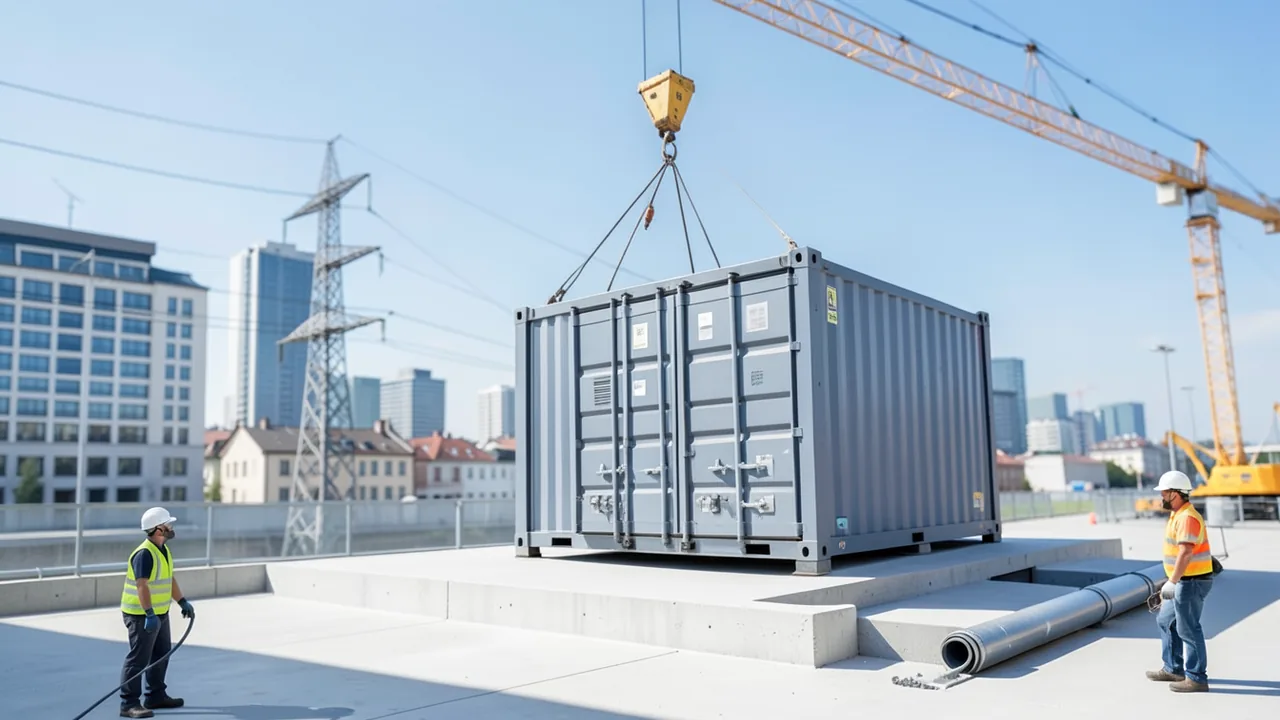
DSX POD: an AI factory in a container
The "DSX POD" is a reference design. Partners can use it to build a complete AI factory on the Vera Rubin platform (Nvidia's chip generation) in a modular container. Integration and testing happen before shipping. If power and cooling are already in place at the site, build time is said to shrink from six months to as little as 14 days. The DSX AI Factory platform, also shown at the event, is said to use up to 30% less power at the same AI performance. Nvidia also cites cooling-water savings of "up to 100%." There is no independent evidence for these claims.
Security for AI agents
Huang said securing agents matters most. Nvidia presented a reference architecture built on OpenShell, an open-source runtime with policy control. It places a kernel-level sandbox between the agent and external systems (a sealed-off environment where the agent can only do what is permitted). Nvidia also announced the "Agentic Knowledge Foundation," a bundle of models and libraries that connects enterprise data such as documents and databases to agents. The "Kumo" model makes predictions from structured data.
Physical AI and open models
With Siemens Healthineers, Nvidia is developing adaptive radiotherapy that tracks the changing tumor position during treatment in real time and adjusts the target. In autonomous driving, Bolt, Lucid, Mercedes-Benz, Volkswagen and Einride showed applications on Nvidia's Hyperion platform. As a starting point for custom enterprise AI, Nvidia pointed to its open model families: Nemotron (language), Cosmos (world models), GR00T (humanoids) and Alpamayo (autonomous driving).
Our take
The biggest news is the attempt to ship data centers like finished products. The time savings apply only if power and cooling are already in place, which is often the real bottleneck. The source gives no prices, delivery dates or independent measurements. The focus on agent security makes sense, but the architecture's details aren't described.
Sources
- Bing News (ko-KR) betanews.net
- Wired – AI wired.com
- Bing News (ko-KR) newstap.co.kr
- Bing News (en-US) computerworld.com
Ask the AI assistant
Questions about this article, installation or background? Our assistant knows this page and runs on our own machine, not in someone else's cloud.
The Assistant is an AI (Gemma 4) and can make mistakes – please check important details against the source. Questions are used only to generate an answer and are deleted after one hour. Please don't enter any personal data.



Comments
What do you think? Already tried it? Write it here, no sign-up needed.
Comments are public. Links aren't allowed, and we delete abusive posts. You can delete your own comment at any time in this browser. Learn more in the Privacy Policy.