
OpenAI's GPT-6 Astra designs a complete AI gadget in under a week
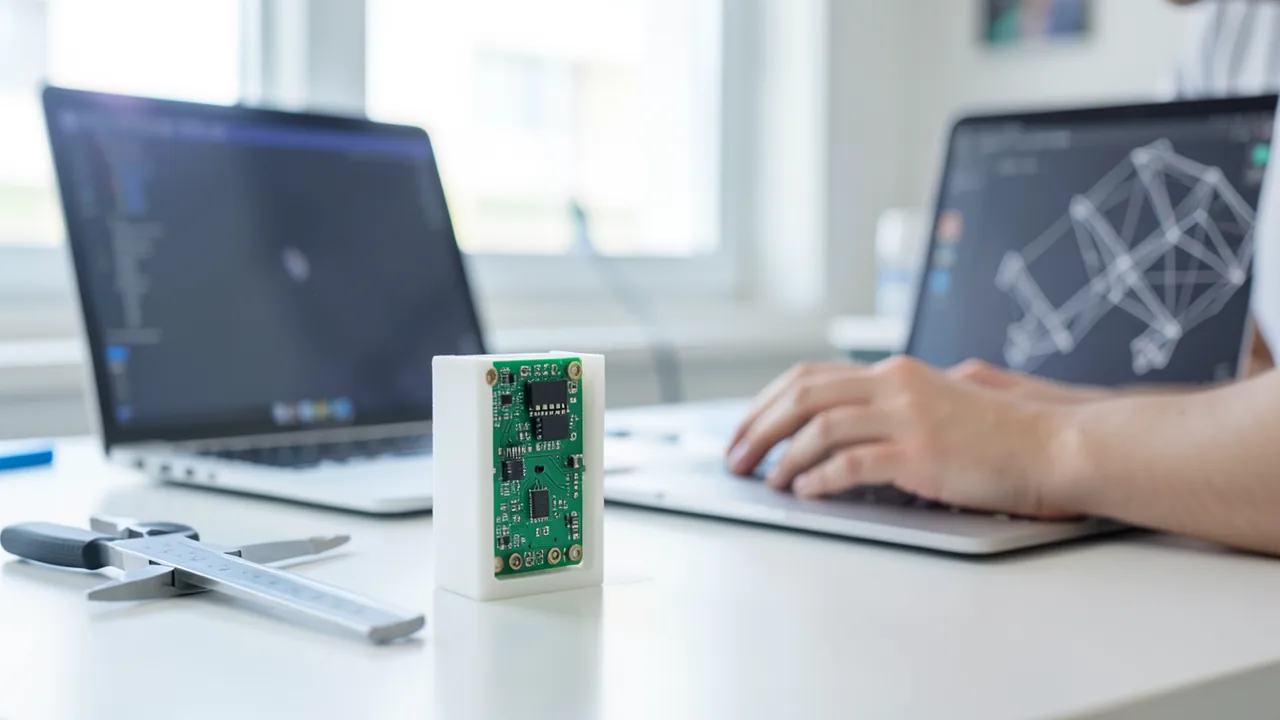
OpenAI says its GPT-6 Astra model designed the enclosure, circuit board, firmware and interface of a device for talking to Codex, as a side project in under a week. A contract manufacturer then built prototypes, though several revisions were needed. OpenAI also announced projects with Chip Ganassi Racing and Mazda.
What's going on
On November 3, 2026, OpenAI presented several projects on physical product development. The centerpiece is an experiment in which the GPT-6 Astra model designed a device that lets users talk to the coding agent Codex. OpenAI also announced an expanded collaboration with the racing team Chip Ganassi Racing and a new research partnership with Mazda. All details come from OpenAI.
The device experiment
The test targeted the model's multimodal capabilities (processing several types of data, such as images and text) and its computer use. Team members did not directly edit the design output. According to OpenAI, Astra handled:
- the functional requirements,
- the enclosure and internal component mounts,
- selection of electrical components and the circuit board design, including component placement and routing,
- the user interface,
- firmware and the software link to Codex.
In an earlier demo, according to unite.ai, the model placed components and routed copper traces in the KiCad software to turn a schematic into a board layout. Two employees designed the device as a side project in under a week. A contract manufacturer then produced a small prototype run in under a month.
Limits: design isn't manufacturing
OpenAI admits that several rounds of review and revision were needed before manufacturing. Astra did not consistently account for production limits, tolerances and assembly requirements. OpenAI is using these weaknesses to determine what future models need to do better. Unite.ai stresses the difference between a complete design and a design that is ready for manufacturing.
Benchmark and internal use
BenchCAD 2.0 tests whether models can rebuild 3D parts and assemblies and identify connections on circuit boards. According to OpenAI, a newer internal model averages 0.875, while GPT-6 Astra at the highest reasoning level scores 0.594. OpenAI doesn't give details on the internal model. The company sees early signs that AI can speed up professional iteration, but stresses that design is only one part of the engineering lifecycle.
Internally, the hardware and infrastructure teams, including in robotics and compute infrastructure, use Codex and ChatGPT for CAD models and changes, manufacturing drawings, simulation setup and design reviews. Token usage has risen 23-fold since February. Unite.ai notes that this measures model consumption, not engineering output or time saved.
Chip Ganassi Racing and Mazda
At Chip Ganassi Racing, the team is testing how to turn 3D scans of existing parts into editable CAD models and 2D manufacturing drawings, especially when the original files are missing. Engineers check accuracy and manufacturability. In the first year of the partnership, the focus was on analyzing sensor, race and pit-stop data.
At Mazda, OpenAI's research and forward-deployed engineering teams are working with aerodynamics and crash-safety engineers. Airflow and structural simulations are used to evaluate vehicle designs, taking styling and cost into account. GPT-6 Astra generates alternative front-end designs, runs airflow simulations and refines promising designs to reduce drag. Mazda chief engineer Akihiro Nakata says simulating dozens of variants helps in understanding which features matter aerodynamically. OpenAI plans to share more results and invites engineering firms and software vendors to submit collaboration proposals.
Our take
The experiment shows that AI agents can tackle hardware design, not just software, largely on their own. But it remains a vendor report with no independent verification. The required revisions and the note about manufacturing limits temper the picture. The benchmark jump concerns an internal model that isn't described in detail and can't be checked. For background: according to The Decoder, OpenAI is working on its own hardware, reportedly somewhere between an AI speaker and a smartphone. Whether the test device is related isn't confirmed. On the model family: according to MacRumors, GPT-6 Astra launched in September, followed by the cheaper GPT-6 Sol and Luna. According to Android Authority, citing the Wall Street Journal, a planned GPT-6.1 Astra was scrapped over safety concerns such as deception.
Related videos
Sources
- The Decoder (DE) the-decoder.de
- unite.ai unite.ai
- androidauthority.com androidauthority.com
- macrumors.com macrumors.com
- The Decoder (EN) the-decoder.com
- Google News (FR) news.google.com
Ask the AI assistant
Questions about this article, installation or background? Our assistant knows this page and runs on our own machine, not in someone else's cloud.
The Assistant is an AI (Gemma 4) and can make mistakes – please check important details against the source. Questions are used only to generate an answer and are deleted after one hour. Please don't enter any personal data.



Comments
What do you think? Already tried it? Write it here, no sign-up needed.
Comments are public. Links aren't allowed, and we delete abusive posts. You can delete your own comment at any time in this browser. Learn more in the Privacy Policy.