
OVHcloud unveils Olala mini, France's second open AI model alongside Mistral
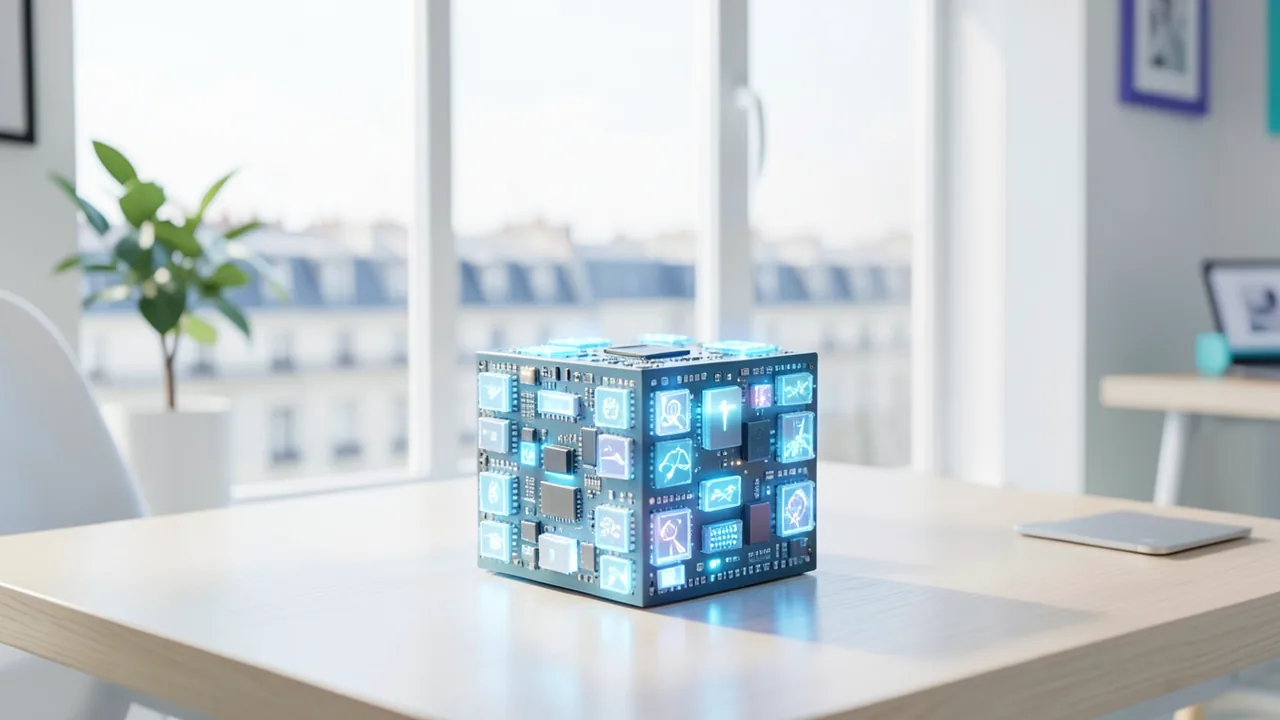
French cloud provider OVHcloud is moving into building its own language models with Olala mini 7A1B. The compact mixture-of-experts model should run on graphics cards with just 8 GB and is set to land on Hugging Face under the Apache 2.0 license on November 19. So far there are no benchmarks.
What's going on
OVHcloud, based in Roubaix in northern France, is Europe's largest cloud provider. Until now it has mostly hosted other companies' AI models on its servers. Now it's building its own. On November 17, 2026, OVH unveiled Olala, which it calls its "first family of LLMs." The first model is Olala mini 7A1B. The official launch is set for November 19 at the OVHcloud AI Summit in the Carrousel du Louvre in Paris. The weights are due on Hugging Face the same day under the permissive Apache 2.0 license. According to ActuIA, OVH will also release the pretrained base model, a technical report and documentation on compliance with the EU AI Act.
The move isn't a total surprise. In June, OVH founder and CEO Octave Klaba announced plans to train in-house models, with early 2027 as the target back then. So the company is ahead of schedule. Numerama's headline sums it up: Mistral AI is no longer alone in France.
How the model is built
The name gives away the key specs. "7A1B" means 7 billion parameters in total, with only 1 billion active per request. That's possible thanks to a mixture-of-experts architecture (MoE). Each layer contains 256 specialized subnetworks, the "experts." A component called the router picks just a few of them for each chunk of text. Think of a big company where a request doesn't go through every department, only the relevant ones. That saves compute and makes the model fast.
The attention mechanism is unusual too. Attention decides how the model relates the words in a text to each other. OVH describes its version as a hybrid of two building blocks:
- Differential-TPA compresses and filters classic transformer attention so it needs less memory and gets less distracted by irrelevant parts of the text.
- Mamba-3 is a state-space model. It reads text like a data stream and keeps only a fixed-size summary in memory instead of remembering every single word. That mainly helps with long texts.
The model ships in BF16, meaning 16 bits per number. The context window is 32,000 tokens. That's how much text the model can take into account at once, roughly 50 to 60 book pages.
The architecture didn't start at OVH. It comes from Dragon LLM, formerly Lingua Custodia, a Paris company that began with financial translation in 2011. OVH announced the acquisition on March 25, 2026, and renamed the company OVHai LLM. According to ActuIA, Dragon LLM won the European Commission's "Large AI Grand Challenge" in June 2024, which earned it 3.2 million compute hours on the Leonardo and Jupiter supercomputers. In October 2025, the company showed a 3.6-billion-parameter prototype, again without benchmarks.
OVH's speed and memory claims, and where they don't add up
OVH shares only a handful of numbers:
| Spec | Value according to OVH |
|---|---|
| Total / active parameters | 7B / 1B |
| Experts per layer | 256 |
| Minimum VRAM | 8 GB |
| Speed on RTX A4500 | 160 tokens/s |
| Speed without a GPU | 50 tokens/s |
| Context window | 32,000 tokens (v1.1: 128,000) |
| License | Apache 2.0 |
ActuIA ran the numbers and found contradictions. In BF16, each parameter takes up two bytes. So 7 billion parameters come to around 14 GB, almost twice the 8 GB that's supposedly enough. There are two possible explanations. Either OVH means a compressed version, a quantization that stores the numbers at lower precision. Or only some of the experts get loaded onto the graphics card. The announcement doesn't say which.
The speed figures have the same problem. The 160 tokens per second were measured on an RTX A4500, a workstation card with 20 GB of memory, not 8. The 50 tokens per second come from a "simple processor," and OVH doesn't say which one. None of these numbers tell you anything about the quality of the answers either.
No benchmarks, and the only customer is family
The biggest criticism: OVH hasn't published any benchmark results. That makes it impossible to compare Olala mini with its direct rivals in the same size class, such as Google's Gemma, Alibaba's Qwen or Mistral's Ministral 3, which also comes under Apache 2.0 in 3, 8 and 14 billion parameter sizes.
The only real-world data comes from the search engine Qwant. It already uses Olala mini for its "Réponse Flash," the AI summaries shown above search results. Qwant says answers arrive 20 percent faster and running costs have dropped to a third, compared with an unnamed previous model. But that claim isn't independent. Qwant belongs to the holding company Synfonium, which according to ActuIA is 75 percent owned by Octave and Miroslaw Klaba, with the remaining 25 percent held by the state-owned Caisse des Dépôts. ActuIA explicitly calls it "internal feedback."
ActuIA suggests three things to check on release day:
- The scores: The technical report needs to show how the model performs on public tests against open models of the same size.
- The real memory footprint: You'll only know what the 8 GB claim actually means once someone loads the weights onto an 8 GB card.
- The training data: Since August 2, 2025, the AI Act has required providers of general-purpose AI models to publish a copyright policy and a public summary of their training data, open models included.
Trained on public compute
Olala mini was trained on three public European supercomputers: Jupiter in Germany, MeluXina in Luxembourg and Jean Zay in France. According to Programmez, the training used A100, H100 and GH200 GPUs. OVH puts the value of the compute hours it received at around 7 million euros and thanks the authorities involved. According to ActuIA, OVH doesn't say which funding program granted the hours. So a company with annual revenue of 1.145 billion euros didn't foot the bill for this first training run on its own.
According to the news agency AFP, just under 100 people work on AI at OVH, spread across three labs in Paris. Mistral has more than 1,000. Klaba told AFP he wants to show that Europe has "its place in every layer of artificial intelligence." According to servicesmobiles.fr, the company now believes it can train LLMs itself in an economically viable way. Klaba puts it like this:
"AI is strategic for OVH."
Why OVH needs the model
According to ActuIA, the decision to go small comes mainly from internal needs. OVHai Workspace, the office suite with messaging, storage and video calls that OVH unveiled in June, is also meant to come in an encrypted version. That requires models that run directly on the user's machine. So Olala is less a Mistral competitor than a building block for OVH products, alongside its acquisitions Seald (encryption), Dragon LLM and Gladia (speech recognition).
Numerama sees a strong sales argument here. OVH has 1.7 million customers and 46 data centers. Just as Google sells Gemini to its business customers, OVH can offer them its open models, probably at low prices. And it's doing so at a time when "AI sovereignty," meaning independence from US and Chinese providers, is a hot topic in Europe.
The next steps are already planned. Version 1.1 is due by the end of the year, with a 128,000-token context window and better mathematical reasoning. Version 2.0 doesn't have a date yet. According to Programmez, it will have more than 100 billion parameters and include specialized models for enterprise agents, cloud DevOps and cybersecurity.
What you need to try it
OVH says a graphics card with 8 GB of VRAM is enough, such as an RTX 3060, 4060 or similar. But as explained above, the full BF16 version takes up around 14 GB. For the uncompressed version, you'll realistically want a card with 16 GB or more, or you can use a quantized version. Without a GPU, the model should run on the CPU, and OVH quotes 50 tokens per second. With only 1 billion active parameters that's plausible, but it depends heavily on your processor. Plan for at least 15 GB of disk space and 16 GB of RAM. One open question remains: because of the unusual Mamba-3 and Differential-TPA architecture, it's unclear whether popular tools like llama.cpp, Ollama or LM Studio will support the model right away. At first, it will probably only run through Python with the Transformers library, including in Google Colab. The exact steps won't be clear until the release documentation is out.
The bottom line
Olala mini is above all a strategic signal. After Mistral, France now has a second provider of open language models, and this one brings something pure AI labs don't have: its own cloud with millions of customers. The permissive Apache license, the released base model and the AI Act documentation are good signs for transparency. The experimental hybrid architecture is interesting for research too.
But a lot is still unproven. Without benchmarks, nobody knows whether Olala mini can keep up with Qwen, Gemma or Ministral. The memory claim doesn't match the size of the weights, and the only real-world data comes from within OVH's own business circle. Whether the model is more than a cheap building block for OVH products will only become clear with the technical report and independent tests after November 19.
Sources
- Numerama (FR) numerama.com
- Le Monde Pixels (FR) lemonde.fr
- actuia.com actuia.com
- servicesmobiles.fr servicesmobiles.fr
- programmez.com programmez.com
Ask the AI assistant
Questions about this article, installation or background? Our assistant knows this page and runs on our own machine, not in someone else's cloud.
The Assistant is an AI (Gemma 4) and can make mistakes – please check important details against the source. Questions are used only to generate an answer and are deleted after one hour. Please don't enter any personal data.

Comments
What do you think? Already tried it? Write it here, no sign-up needed.
Comments are public. Links aren't allowed, and we delete abusive posts. You can delete your own comment at any time in this browser. Learn more in the Privacy Policy.