
Saab's own AI now flies the Gripen E fighter jet, without outside help
Swedish defense company Saab has let AI agents it built itself fly a combat-ready Gripen E fighter jet in simulated long-range air combat. A year ago, the software for this came from Munich startup Helsing. Now Saab owns the whole chain, from training to flight testing, and wants to get the technology into service as fast as possible.
What's going on
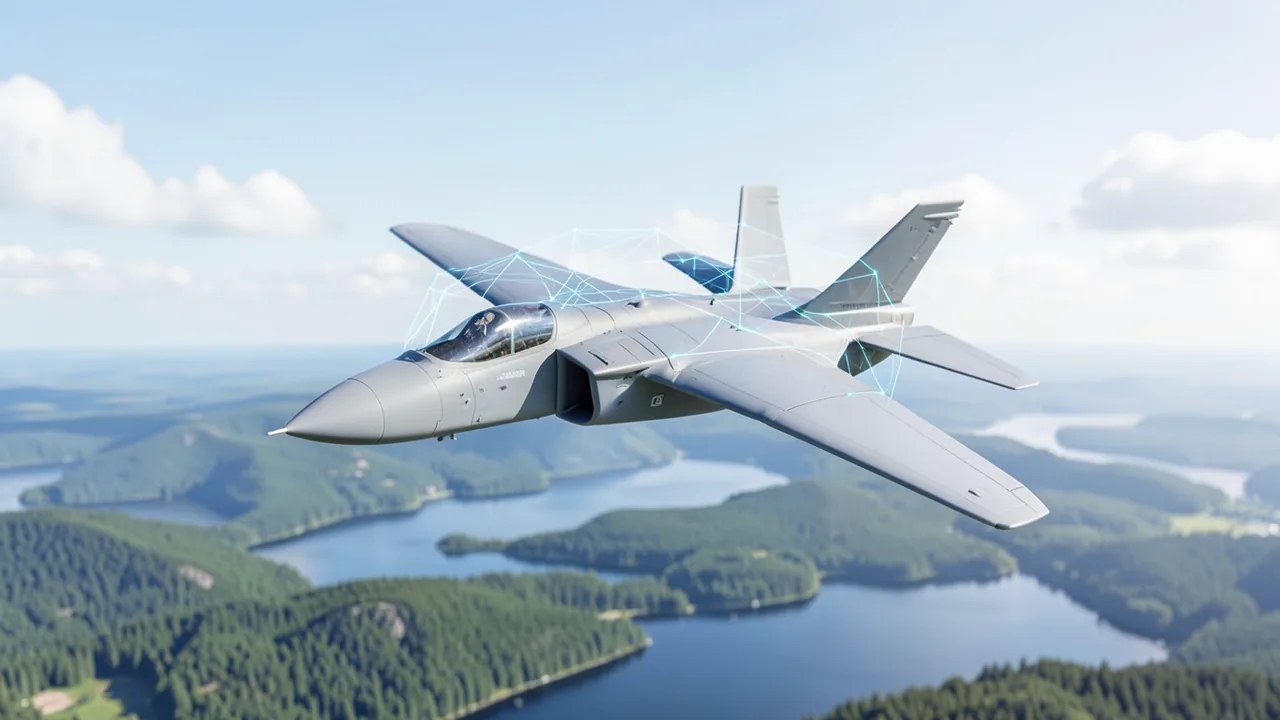
Swedish defense and aerospace group Saab announced on November 3, 2026, that AI agents it developed in-house have flown a Gripen E fighter jet in the air. An AI agent is software that perceives its environment, weighs possible actions and then decides on its own, based on set goals and rules. It doesn't just run through a fixed list of commands. The tests didn't take place in a simulator or on a specially modified test aircraft. The software ran on a regular, combat-ready fighter jet.
The jet flew simulated "Beyond Visual Range" (BVR) engagements, meaning air combat at distances where the opponents can't see each other with the naked eye. Instead, they find each other with radar and other sensors and fight with long-range missiles. According to Saab, one of the agents took control of the jet and flew the tactical maneuvers. The announcement came alongside the International Fighter Conference 2026 in Munich, where Saab executive Peter Nilsson spoke with trade outlets such as Janes.
From a bought-in agent to homegrown AI
An AI flying a Gripen isn't the news here. The news is who wrote the software. Under "Project Beyond" in 2025, Saab integrated Centaur, an AI agent from German defense AI company Helsing, into a Gripen E in less than six months. In three flights between May 28 and June 3, 2025, Centaur went up against a human-flown Gripen D. According to Army Recognition, it tracked the opposing aircraft using real sensor data, flew tactical maneuvers and showed the pilot on board when to fire. Whether to actually shoot was still the human's call.
Back then, Saab varied four conditions: starting distance, speed, angle of approach to the opponent and access to external command data (Command and Control, or C2). That link was also deliberately cut.
In the current campaign, the agents, training environments and test tools all come from Saab. According to Army Recognition, they're the result of two years of development in the Advanced Programs unit led by Peter Nilsson. He told Janes:
"We have been flying our own Saab AI agents for two years now. The AI Fighter Pilot Academy is about building a new industrial capability – not another isolated experiment."
And according to Spanish newspaper Libertad Digital: "Because we own the entire technology stack, we are developing the capabilities needed for that future."
Army Recognition points out one difference from 2025: Saab hasn't published a comparable test matrix for the new flights. So nobody outside knows the exact conditions they were flown under.
The "academy" for AI pilots and the compute behind it
At the heart of the project is the AI Fighter Pilot Academy (AIFPA). It isn't a building but a software infrastructure where agents are developed, trained and evaluated. Training relies mainly on reinforcement learning, or learning through rewards. The software plays through countless engagements and is told each time whether its decisions achieved the goal, a bit like training a dog with treats. According to AINonline, Saab also trains language models there and combines different agents into so-called hybrid agents. The agents have now logged millions of simulated flight hours. The infrastructure is designed to be reusable: new missions, scenarios and aircraft types can be added without rebuilding everything.
For a long time, compute was the bottleneck. Saab had been working with CPU-based systems, meaning conventional processors. Those were enough to get an agent ready for flight, but not to keep improving it. That changed with the Sferical One data center in Linköping. Saab is a founding partner of the Sferical AI initiative, alongside Ericsson, AstraZeneca, SEB, Wallenberg Investments and SKF. The facility is built on Nvidia's DGX SuperPOD with 1,152 Grace Blackwell GB300 GPUs and cost more than SEK 1 billion.
| Compute environment | Simulations of a one-hour test flight in the same time |
|---|---|
| CPU-based (previously) | 1,200 |
| Sferical One (1,152 GB300 GPUs) | 1 billion |
Figures according to AINonline
AINonline says this turns AI training into an industrialized, continuous process rather than a project limited by available time. Army Recognition adds a critical note: the compute may sit inside Sweden, but the hardware depends on foreign chipmakers. Saab has also set up a separate business unit called "Common Technology" that pulls together AI development across all its divisions.
For comparison, Helsing trained Centaur on its "RL-Factory" infrastructure using reinforcement learning and self-play, meaning it fought copies of itself that kept learning too. According to Army Recognition, that added up to more than 500,000 simulated flight hours, the equivalent of 57.1 years of nonstop operation. Helsing's VP of AI, Antoine Bordes, said the version flown on June 3, 2025, had gathered the equivalent of 50 years of pilot experience in just a few hours of training. Army Recognition makes clear that this describes the amount of compute and says nothing about human-like skill.
Why the Gripen E is a good fit
What makes this possible is the Gripen E's software-defined architecture. Mission applications are strictly separated from the safety-critical flight controls. The AI can send permitted control commands, but it doesn't replace the software that keeps the aircraft stable in the air. Think of apps on a smartphone that aren't allowed to change the operating system.
According to Army Recognition, the Gripen E has an F414-GE-39E engine with 98 kN of thrust with afterburner, is 16.5 meters long and reaches Mach 2 at high altitude. It carries an ES-05 Raven AESA radar with a swashplate-mounted antenna (100-degree field of view to each side), the Skyward-G infrared sensor and the Arexis electronic warfare system. Weapons for long-range engagements include the Meteor missile, with a range of more than 100 km, and the AIM-120 AMRAAM.
BVR combat demands constant decisions: How do you keep the opponent on radar while widening the lateral distance? When do you turn away to escape an incoming missile? With several targets and threats in play at once, this quickly becomes too much for a human. That's exactly where the AI is meant to help. According to Saab, the agents will either support the pilot in the cockpit or fly uncrewed aircraft that operate alongside crewed jets.
Money, competition and future plans
The Swedish state is backing the project. The procurement agency FMV fully funded Project Beyond. For research into future combat aircraft, Saab also received a SEK 2.6 billion contract on October 14, 2025 (2025–2027) and a SEK 2.9 billion contract on September 9, 2026 (2026–2028, with options through 2030). According to Army Recognition, that money goes into all research on crewed and uncrewed aircraft, not just AI.
Saab isn't alone in this approach. In the US, DARPA's ACE program used the modified F-16 X-62A VISTA to fly autonomous dogfights against human pilots. The US Air Force is developing the uncrewed wingmen YFQ-42A (General Atomics) and YFQ-44A Fury (Anduril) in its Collaborative Combat Aircraft program, and Shield AI is working on the vertical-takeoff X-BAT. On August 22, 2026, at Malmen air base, Saab itself unveiled the uncrewed combat aircraft concept A3-001, designed for electronic warfare, suppression of enemy air defenses and strike missions. Autonomous flight demonstrators are planned before 2030. According to Army Recognition, there are no quantities, costs or service-entry date yet. In the long run, this is part of Sweden's Vägval Stridsflyg program, which is preparing a Gripen successor for the 2040s and beyond.
According to AINonline, Nilsson considers the agents ready for operational use. The only limit, he says, is how quickly FMV and the air force can adopt them, which could take "months or single-digit years."
Analysis
Technically, this is a big step: a European aircraft maker now controls the entire chain itself, from the training environment and compute to flight tests on a production jet. You'll recognize the pattern from civilian AI. The real advantage lies less in any single model than in the "factory" that trains, tests and keeps improving models. In defense, sovereignty is an added factor. If you build the software yourself, you can check its behavior more closely and don't have to rely on suppliers.
A lot remains open. For the new tests, Saab has published neither evaluation criteria nor results against human opponents. According to Army Recognition, the biggest problem is transferring from simulation to reality, with radar errors, jammers, dropped data links and unknown opponents. Saab doesn't say how many of the simulated engagements included such conditions. It's also unclear how much decision-making power the software will get in the future. In 2025, the decision to shoot still rested with the human. Advances like this make the debate over autonomous weapons systems more concrete. And the announcement is a technology milestone, not a contract: as ad-hoc-news notes for investors, it comes with no new orders or financial guidance.
Sources
- Bing News (es-ES) ecosistemastartup.com
- Bing News (en-US) armyrecognition.com
- ad-hoc-news.de ad-hoc-news.de
- janes.com janes.com
- aviacionline.com aviacionline.com
Ask the AI assistant
Questions about this article, installation or background? Our assistant knows this page and runs on our own machine, not in someone else's cloud.
The Assistant is an AI (Gemma 4) and can make mistakes – please check important details against the source. Questions are used only to generate an answer and are deleted after one hour. Please don't enter any personal data.



Comments
What do you think? Already tried it? Write it here, no sign-up needed.
Comments are public. Links aren't allowed, and we delete abusive posts. You can delete your own comment at any time in this browser. Learn more in the Privacy Policy.