
ScanRuler: Free browser tool measures 3D scans, and an AI agent rebuilds them in CAD
Stefan Hermann of the YouTube channel CNC Kitchen has released ScanRuler, a free, open-source tool that measures 3D scans in your browser and compares them with design data. Through an interface, an AI agent like Claude Code can even rebuild the scan as an editable CAD model. Until now, that kind of work has mostly needed expensive professional software.
What it's about
Hobbyists can now buy a 3D scanner for a few hundred euros. But the bundled software usually does just one thing: it captures an object and saves it as a triangle mesh. If you want to measure the scan, compare it with your own design or turn it into a replacement part, you usually need expensive professional software. Makers have long relied on GOM Inspect, a free metrology program from the industrial world. Since Zeiss took it over, though, heise reports that you can only get it by registering with a company email address.
So Stefan Hermann, known for the YouTube channel CNC Kitchen, built his own tool: ScanRuler. It's free, open source and runs directly in your browser at scanruler.com. What sets it apart is that an AI agent can operate the program through an interface and rebuild a scan on its own as an editable CAD model. CAD stands for computer-aided design, the kind of model engineers use to design parts.
Runs locally in the browser, nothing to install
ScanRuler runs in the browser, but all the computing happens on your own machine. According to heise, there's no installation, no tracking and no cookie banner, and your files never leave your computer. That's possible thanks to WebAssembly, a technology that lets programs run in the browser almost as fast as regular installed software. Under the hood, it relies on proven open-source libraries:
- Open CASCADE (LGPL 2.1) as the geometry kernel for the CAD features, meaning the engine that describes exact surfaces and solids
- Manifold (Apache 2.0) for Booleans, operations like adding, subtracting or intersecting solids
- meshoptimizer (MIT) for decimating triangle meshes
The tool can import scans as STL, PLY, OBJ, 3MF or STEP.
The workspaces at a glance
ScanRuler is split into several workspaces:
| Workspace | What it does |
|---|---|
| 3D Measure | Fit spheres, cylinders, cones, tori, planes and circles into the scan with a click. Measure distances, angles and geometric tolerances, export as STEP |
| Deviation | Automatically align the scan to the original CAD model and show deviations as a color map |
| Wall thickness | Display wall thickness as a color map, no reference model required |
| 2D Measure | Measure flatbed scans or cross-sections, export as SVG, DXF or CSV |
| Reverse engineer | Derive sketches from sections through the scan, extrude, fillet, add threads |
| Mesh Tools | Fill holes, smooth, Booleans, "Trim to Scan" |
For 3D measurement, according to 3Druck.com, you just click on a surface. The tool picks the right region itself and fits the primitive shape into it. You can then measure distances and angles, as well as geometric tolerances (GD&T, a standardized system designers use to specify things like flatness or concentricity, meaning how precisely two holes line up on one axis). You can export the fitted features with exact geometry as a STEP file, the standard exchange format between CAD programs.
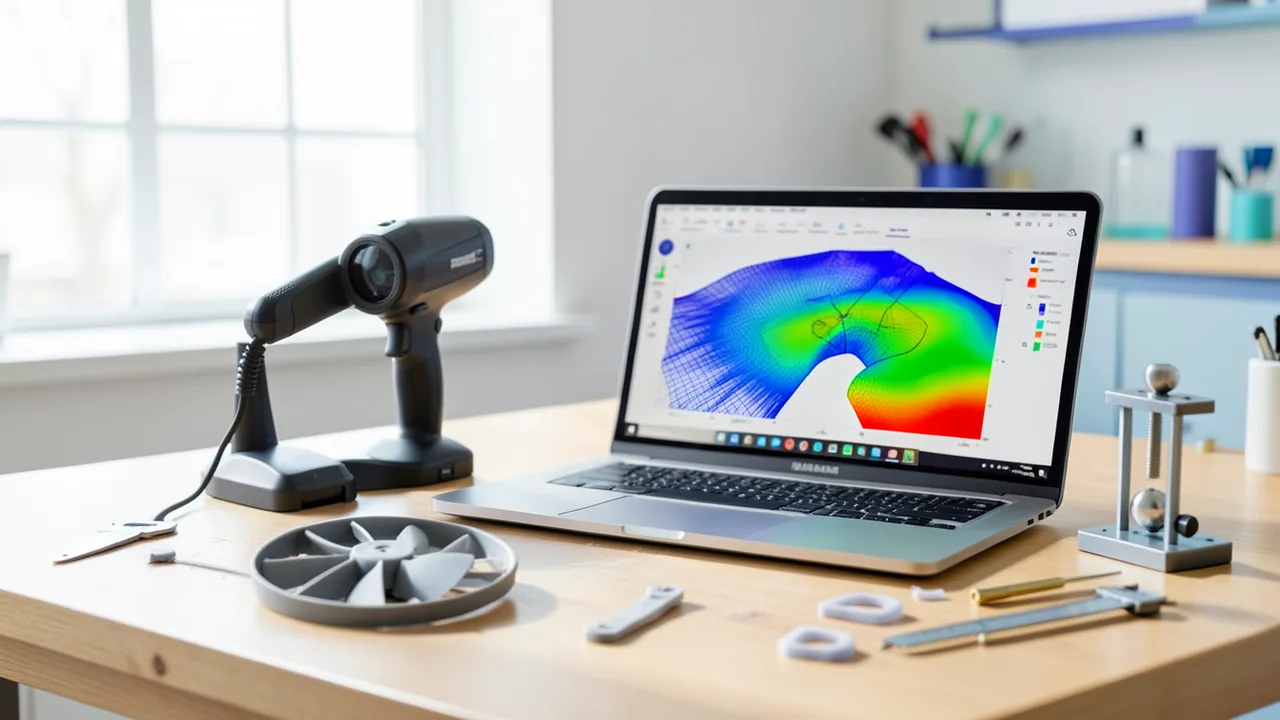
The Deviation workspace is especially useful for 3D printing. The program overlays the scan of a printed part on the original model and color-codes where the part is too thick, too thin or warped. That makes warping and shrinkage visible. According to 3Druck.com, you can use a mesh or a STEP file as the reference. If supports or fixtures got scanned along with the part, you can exclude them from the alignment.
For flat parts, there's 2D measurement using an ordinary flatbed scanner. At 600 dpi, one pixel equals 42 micrometers, according to 3Druck.com. The Reverse engineer workspace is really a small parametric CAD program that also works without a scan. Parametric means the model is built from dimensions and operations you can change later, rather than from fixed triangles. Among the Mesh Tools, one feature stands out: "Trim to Scan" fits a replacement piece precisely to the broken edge of a damaged part.
How accurate is it?
Hermann compared ScanRuler with GOM Inspect. On the center-to-center distance between the spheres of a ball bar, a common test artifact in metrology, ScanRuler measured 148.639 millimeters and GOM Inspect 148.64 millimeters, according to 3Druck.com. So the values match down to the last displayed digit. But that's a single comparison run by the developer himself. There's no independent testing across many different parts yet. And in the end, no software can be more accurate than the scan you feed it.
An AI agent as design engineer
Turning a scan into a clean, editable model takes a lot of time and expertise, even with good tools. That's where the AI part comes in. A helper service called scanruler-mcp lets an AI agent control every workspace. MCP stands for Model Context Protocol, an open standard that lets AI models operate other programs, a bit like a remote control. According to 3Druck.com, Claude Code, Codex, Claude Desktop and Cursor all work. The agent works visibly in the open browser tab, and you can undo every step.
According to heise, the process goes like this: The agent examines the scan, classifies the part, asks about requirements and then builds the model feature by feature, hole by hole and chamfer by chamfer. Afterwards, it checks the result against the deviation map. The output is a STEP file, an editable project and a report. In other words, the agent doesn't try to blindly convert tens of thousands of triangles into surfaces. Instead, it reconstructs the design intent: How would a person have originally designed this part? You can correct it with notes pinned directly to the part.
Results depend heavily on the model you use. Hermann got the best ones with Claude Opus 5.5. Weaker and locally running models delivered noticeably worse results, heise reports. Simple parts take anywhere from a few minutes to an hour, complex ones much longer. One fan impeller took 106 minutes and 284 tool calls, which eats a good chunk of your AI subscription's usage limit. Freeform surfaces and rough castings remain the weak spot.
One important privacy note: When an agent is connected, measurement data, images and file names go to the respective AI provider. But the agent is optional. Without it, everything stays on your own computer.
License and plans
Hermann himself calls ScanRuler a "vibe coding" project, meaning he wrote it largely with AI assistance, putting in several weeks of work. The source code is on GitHub under the AGPL-3.0. This license requires that derivative software, including software offered to others as a web service, be open-sourced as well. If you want to build ScanRuler into closed-source software, you can get a commercial license from CNC Kitchen.
According to 3Druck.com, more features are planned:
- additional Chebyshev fitting methods, a common metrology technique for fitting shapes to measurement points
- slots as a new feature type
- position and runout tolerances
Just this spring, Hermann released BumpMesh, another free browser tool, this one for 3D printing textures.
Our take
ScanRuler fills a real gap. Cheap scanners are everywhere, but since GOM Inspect effectively stopped being freely available, there's been no free tool between them and the expensive industrial metrology and reverse engineering suites. For makers who design replacement parts or want to check the dimensional accuracy of their prints, this is a big step forward. And since everything runs locally in the browser, it's easy to get started.
The AI agent is the most exciting part, but also the least proven. It shows how agents can use MCP to operate specialist software, transparently and step by step. The limits are clear, though: So far, good results require an expensive frontier model, complex parts take a lot of time and usage quota, and freeform surfaces don't work well. On top of that, a connected agent sends data to cloud providers, which is a problem for confidential company parts. The accuracy claims also come from the developer himself so far. Independent tests are still pending. And as one person's vibe coding project, ScanRuler still has to prove how well it will be maintained over the long run.
Related videos
Sources
- NewsData (germany) heise.de
- finance.yahoo.com finance.yahoo.com
- 3druck.com 3druck.com
- de.finance.yahoo.com de.finance.yahoo.com
Ask the AI assistant
Questions about this article, installation or background? Our assistant knows this page and runs on our own machine, not in someone else's cloud.
The Assistant is an AI (Gemma 4) and can make mistakes – please check important details against the source. Questions are used only to generate an answer and are deleted after one hour. Please don't enter any personal data.



Comments
What do you think? Already tried it? Write it here, no sign-up needed.
Comments are public. Links aren't allowed, and we delete abusive posts. You can delete your own comment at any time in this browser. Learn more in the Privacy Policy.