
Stringman: an open-source ceiling robot that tidies the kids' room like a claw machine
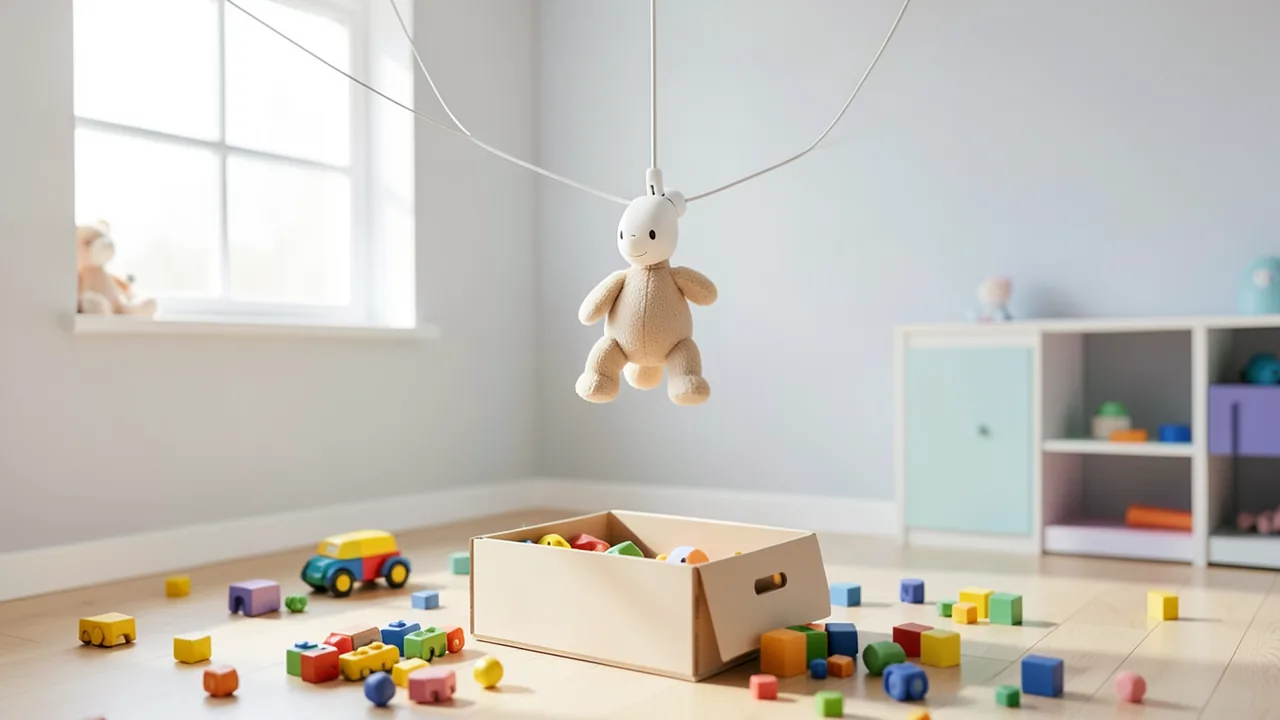
A US engineer has built a tidying robot that doesn't drive around your home. It hangs from four lines below the ceiling and plucks toys and laundry off the floor like a claw machine. The plans and software are free, and a ready-built unit costs $965.
What's going on
US engineer Nathaniel Nifong and his company Neufangled Robotics have built a tidying robot called Stringman. It works differently from most household robots. Instead of rolling or walking around your home, it's mounted under the ceiling. A two-finger gripper hangs from four lines anchored in the four corners of the room. Like a claw machine at the fair, it moves over the floor, picks up toys, clothes or trash, and drops them into a laundry basket, toy box or trash can. The Japanese tech site Gigazine and heise reported on it.
Stringman is open-source hardware: the build plans, parts list and control software are all freely available. The project page is neufangled.com, and the source code is on GitHub under the Apache 2.0 license. According to heise, the device is mainly meant to help tidy up kids' rooms.
The idea: grabbing, not fine motor skills
According to Gigazine, Nifong got the idea because he kept doing the same chores over and over: toys back in the box, laundry in the basket. He noticed that these tasks barely need any finesse. You just grab an object and drop it over a container. Two fingers and centimeter-level accuracy are enough for that.
To get directly above every object even in a cluttered room, the gripper hangs from above. One upside: moving through the room takes just four motors, which keeps the price down. heise compares it to the cable cams that glide over the field under stadium roofs.
How the mechanics work
Two of the four corners get an anchor unit, the other two just an eyelet, a ring that a line runs through. Each anchor holds two spools, each with its own motor. From each anchor, one line runs straight to the gripper, while the second first runs through the eyelet in the neighboring corner. All four lines meet above the gripper. To move the gripper sideways, the motors on one side reel in line while those on the other side let it out. That way it moves forward, back, sideways, up and down.
Three of the lines are fishing line. The fourth doubles as the power cable. So the gripper draws power straight from the wall outlet and never needs charging.
A rod runs down from the point where the lines meet, with the gripper at its end. According to heise, that puts it about 50 centimeters below the suspension point. This keeps the lines higher up and lets the gripper reach right next to a bed or desk and, according to heise, under furniture or behind obstacles. At first, the gripper hung from a fifth line, but that swung too much. The rod has another advantage: it acts as a brace when the wrist rotates. That lets the gripper line up its fingers with long or flat objects. According to heise, a pressure-sensitive pad keeps soft items from being squeezed too hard.
Cameras, control and AI
A black-and-white marker sits on top of the rod. A control PC estimates the gripper's position in two ways and combines the results: from the line lengths, and from images taken by two cameras in the anchors that track the marker. A third, wide-angle camera sits on the gripper itself. According to heise, the motors and gripper are run by three Raspberry Pi Zero boards, tiny single-board computers.
The interface runs in your browser. It shows a 3D top-down view of the room in the middle and the feeds from all three cameras on the right. You can drive Stringman by hand with a gamepad or keyboard. When moving sideways, the gripper sometimes swings like a pendulum. To counter that, there's optional damping: the PC adjusts how fast each line is reeled in and out. No extra motors needed.
In automatic mode, you pick what to pick up in the interface, or let an AI search the camera feed for candidates. Detected items land in a list, and you can strike items off it. The target containers get their own clip-on markers. That way the robot knows where the laundry basket, toy box and trash can currently are. The toys and clothes themselves don't need any markers. In demo videos, Stringman picks up a dark piece of clothing in front of a bed and drops it into the basket. Another video shows it tidying a whole room full of toys at 50x speed.
According to heise, the robot is controlled and trained via LeRobot, Hugging Face's open-source robotics platform. With imitation learning, a human controls the robot remotely (teleoperation), and the AI learns from these demonstrations. The interface records camera images and control commands as training data.
Setup, room size and payload
The anchor brackets are screwed into a wooden stud in the wall or strapped to load-bearing posts. Then you hang the anchors and connect the lines to the gripper. For calibration, you lay sheets of paper with black-and-white patterns on the floor and start the process. Using these patterns, the software works out exactly where the anchors and eyelets hang. It runs automatically and takes about five minutes, according to the maker.
| Spec | Maker's figure |
|---|---|
| Smallest room (guideline) | approx. 2 × 2 m, 1.5 m high |
| Largest room (guideline) | approx. 5 × 5 m, 3 m high |
| Max. distance between diagonal corners | 7.5 m |
| Avg. payload (5 × 5 × 2.5 m, 28 N per line) | 2.1 kg |
| Kit price | approx. $630 |
| Fully assembled price | $965 |
How much the gripper can lift depends on where it is. Near the floor, the lines run steeply upward and pull up harder. In the middle of the room, all four lines share the load more evenly. So it handles the most weight there, just above the floor. You can run the numbers for your own room with the maker's Payload Explorer. Enter your room dimensions and line tension, and it shows in 3D how much is possible at each point.
For the control PC, Neufangled recommends an eight-core CPU and hardware that accelerates AI workloads, with at least 2 GB of VRAM (video memory). Without that acceleration, you switch off the AI features and drive it by hand. Everything can stay on your home network. If you link the device to a Neufangled account, you can also view and control it in a browser while you're out. The PC at home has to keep running, though.
Prototype limits
Neufangled itself calls Stringman a prototype. It doesn't avoid furniture and other obstacles on its own, and sometimes a human has to steer the gripper around them. According to heise, Nifong stresses that the project is under ongoing development. Image recognition is set to improve, and it can't yet reliably grab thin objects like books. Later on, Stringman is supposed to put things back where they belong, not just toss them into fixed containers.
The bottom line
Stringman sidesteps the hardest problems in household robotics with a trick: it doesn't walk, it doesn't balance and it doesn't need a battery. It just hangs above everything. Pricey robot arms on mobile bases, or the humanoid home helpers getting so much attention right now, take a far more complex route to the same job. In return, Stringman is tied to one room, has to be fixed to walls or posts, and can only roughly grab, drop and collect. The lines cross the room, and the sources don't say whether that gets in the way in daily life, say with ceiling lights, tall cabinets or kids at play. There are no independent tests of reliability or speed yet either. All figures come from the maker.
The project is most exciting for makers and the open-source robotics scene. Thanks to the Apache 2.0 license, 3D-printed parts and LeRobot integration, you can build it yourself, modify it and train it on your own data. At $965, Stringman is also far cheaper than most household robots with a gripper arm.
Related videos
Sources
- Hatena Bookmark IT (JP) gigazine.net
- theregister.com theregister.com
- heise.de heise.de
Ask the AI assistant
Questions about this article, installation or background? Our assistant knows this page and runs on our own machine, not in someone else's cloud.
The Assistant is an AI (Gemma 4) and can make mistakes – please check important details against the source. Questions are used only to generate an answer and are deleted after one hour. Please don't enter any personal data.


Comments
What do you think? Already tried it? Write it here, no sign-up needed.
Comments are public. Links aren't allowed, and we delete abusive posts. You can delete your own comment at any time in this browser. Learn more in the Privacy Policy.