
Trained Without Nvidia: What China's AI Independence Really Costs
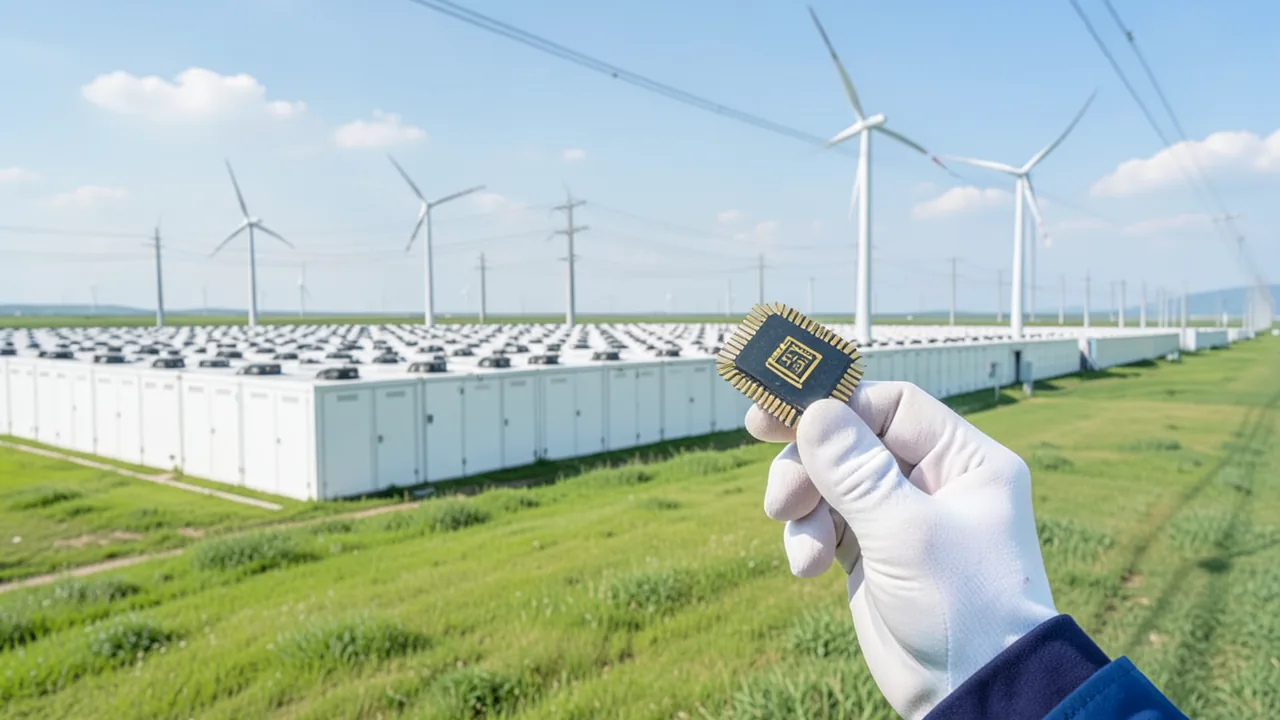
Meituan, Alibaba, Z.AI and DeepSeek are all touting models trained on Chinese chips. We checked those claims against the hard numbers, from Epoch's satellite analysis to chip counts and power draw. The verdict: training without Nvidia works, but it costs many times more in chips, power and time.
What's going on
In China's AI industry, “trained without Nvidia” has gone from rare exception to marketing pitch in a matter of weeks. In early November, Meituan released the weights for LongCat-2.5, which its model card says was built on “domestic AI accelerators.” On November 19, Alibaba CEO Eddie Wu told analysts on the earnings call that Qwen is training its next generation on chips from the group's subsidiary T-Head. Z.AI, formerly Zhipu, runs a 1-gigawatt data center using only Chinese chips, according to Bloomberg. And DeepSeek is reportedly set to train V5 on Huawei's Ascend 950.
Our thesis: for training, China no longer depends on Nvidia. The price is far more chips, more power and less speed. We had to correct one assumption along the way: China isn't short on power. What's scarce is memory chips and performance per watt.
Who claims what, and what's actually backed up
| Company | Claim | Source | Status |
|---|---|---|---|
| Meituan | LongCat-2.0/2.5 trained on domestic chips, 50,000-chip cluster | Company statements, model card | No chip supplier named |
| Alibaba | Qwen training next generation on T-Head chips | Earnings call, Nov 19 | Official, but no chip counts |
| Z.AI | 1 GW data center using only Chinese chips, partially operational | Bloomberg, one anonymous source | Chipmaker unknown |
| DeepSeek | V5 on Ascend 950, 160,000 Ascend 950DT ordered | Caiwen, Bloomberg, The Information | Unconfirmed, reports contradict each other |
Meituan: According to the Hugging Face model card, LongCat-2.5 uses “infrastructure optimizations on domestic AI accelerators.” Huawei isn't mentioned. The operating guide in the SGLang-FluentLLM GitHub repo is the first place it gets specific: the example runs on a cluster of 194 Atlas A2 cards from Huawei. Two handle the image encoder, 64 process the input and 128 generate the response. It runs in W4A4, meaning both weights and intermediate values use just 4 bits. For the predecessor, Meituan cited a 50,000-chip cluster. Based on the stated memory size of under 80 GB, Tech Buzz China concludes these were probably chips from the older Ascend 910B class. A 910C has 128 GB; the 950 series has 112 to 144 GB.
Alibaba: According to the transcript, Wu said:
Qwen is already training its next-generation model on T-Head's domestic chips.
He added that the Model Studio platform (Bailian in Chinese) already runs its inference on domestic chips. Inference means the finished model answering requests. Wu did not say that the just-released Qwen4-Max was built this way. By the first quarter of 2027, T-Head chips are supposed to be able to take over training of “ultra-large” models completely. The successor chip, the Zhenwu V900 with 216 GB of memory, is said to be three times as fast as the M890 and is slated for volume production in Q1 2027.
Z.AI: One thing is documented: in January 2026, Z.AI trained its image model GLM-Image entirely on Huawei Atlas 800T A2 servers. The model is small, combining 9 and 7 billion parameters. According to Digital Applied, Z.AI has never officially confirmed what hardware its large language model GLM-5 was trained on. The widely circulated figure of 100,000 Ascend chips comes only from secondary sources. For the 1 GW data center, there's just one anonymous source, cited by Bloomberg (July 20). According to that source, the facility is partially operational and consists of several clusters of more than 10,000 chips each. The chipmaker and total chip count are unknown, as is which GLM model was trained there.
DeepSeek: The original Caiwen report is more cautious than the headlines. It says V5 training is “still in the selection phase” and is due to finish in 2027. The planned Ascend data center in Ulanqab is still early in construction, and V5's first training run won't necessarily happen there. Bloomberg reported on September 4 that at least 160,000 Ascend 950DT had been ordered. Bloomberg said those chips were meant for inference at first, while training would continue on Nvidia. The Information, by contrast, wrote that pretraining would start as early as late 2026. The frequently cited $2.56 billion is an extrapolation by some media outlets (160,000 chips × roughly $16,000), not a confirmed contract value.
The independent yardstick: Epoch's satellite view of Horinger
On November 6, the research institute Epoch AI published its estimate of Huawei's Horinger data center campus in Inner Mongolia. It started from the rooftop cooling equipment visible in satellite images. Epoch estimates the site holds around 105,000 Ascend 910C and 8,000 910B chips. That's roughly 81,000 H100 equivalents, using Nvidia's H100 as the standard unit. The 90 percent range runs from 36,000 to 141,000. According to Epoch, a 910C counts as 0.76 H100, and an Nvidia B200 or B300 counts as 2.5. The 910C also uses about 2.5 times as much energy per operation.
Epoch's key finding:
A given power capacity supports only 40 percent of the compute of leading US facilities.
For scale: Epoch says 10 percent of Horinger's capacity could train a model the size of DeepSeek-V4-Pro in about a month. A model with 10²⁷ operations, the next size class at the frontier, would take the entire campus about 361 days. And that assumes the campus can be linked into a single training run at all.
Running the numbers: what a megawatt and a dollar buy you
We put the figures from Epoch's database side by side:
| Huawei Horinger | xAI Colossus 2 | |
|---|---|---|
| IT power | 170 MW | 946 MW |
| Compute | ~81,000 H100e | ~1,112,000 H100e |
| H100e per megawatt (our calculation) | ~476 | ~1,175 |
| Capital cost (Epoch model) | $6.4B | $35.8B |
| Cost per H100e (our calculation) | ~$79,000 | ~$32,000 |
476 divided by 1,175 is 0.41, which confirms Epoch's 40 percent figure. Treat the cost figures with caution: Epoch derives them from a flat cost-per-watt model. So the factor of roughly 2.5 mostly reflects lower efficiency. It isn't a measured bill. At the chip level, the gap is even wider. According to Epoch, a B300 delivers about 0.34 TFLOPS per dollar on paper, an Ascend 950DT about 0.05. That's nearly a factor of 7.
The time penalty is starker still. Tech Buzz China and analyst Ryan Cunningham estimated how long it would take to train a model the size of Kimi K3, at an estimated 2.4 × 10²⁵ operations. On 50,000 Ascend 950DT, it would take about 49 days (range 33 to 146); on 50,000 Nvidia GB300, about 5 days. For LongCat-2.0, Tech Buzz estimates around 10²⁵ operations and roughly 33 days on 50,000 chips. Both estimates assume an MFU of 30 percent, meaning the chips use 30 percent of their theoretical compute on average. In an investor call whose transcript later leaked, DeepSeek founder Liang Wenfeng put about 16,000 Huawei chips on par with roughly 4,000 Nvidia B-series GPUs. According to Tech Buzz, that 4:1 ratio holds for inference. For frontier pretraining, however, a GB300 is 8 to 10 times faster than a 910C or 950DT.
The new 950DT does less for efficiency than you might expect. It delivers 1 PFLOPS in FP8 and 2 PFLOPS in FP4, with 144 GB of memory that Huawei developed in-house. On peak 8-bit performance per joule, Epoch actually rates it below the 910C, at 516 versus 964 GFLOP/J. Its advantages are the new FP8 and FP4 number formats and much faster memory. That's why Tech Buzz puts it roughly on par with the GB300 on energy per generated token in inference. It's a big step for inference but a small one for training.
The real bottleneck isn't power
It seemed reasonable to assume China is running out of power. Epoch disagrees: “China does not appear to face a shortage of energy for data centers.” The grid around Horinger could handle 3.5 times today's capacity. So more compute comes from more grid connections, not from more efficient chips. Epoch puts the expansion stage planned for early 2028, with 76,000 Ascend 950DT, at 135 MW.
What's scarce is the chips themselves, or more precisely HBM, the fast stacked memory that every AI accelerator needs. SemiAnalysis calls HBM the bottleneck. It estimates that Chinese manufacturer CXMT can supply around 2 million memory stacks in 2026, enough for 250,000 to 300,000 910C chips. Epoch estimates Huawei's 2026 output at about 1.5 million chips, or 0.88 million H100 equivalents. Nvidia will ship around 23 million that same year, which puts Huawei at less than 4 percent. Seen this way, a single order of 160,000 chips like DeepSeek's is enormous. According to Bloomberg, delivering it could take more than a year.
On top of that comes pressure from Washington. On November 16, the US Commerce Department issued a rule that requires data centers worldwide to get a license before renting compute to companies headquartered in China. The threshold is 12 million TPP, roughly 750 H200s according to CSIS. That shuts the loophole of renting Nvidia compute abroad. On the call, Wu called the rule a “very big uncertainty” and hinted that Alibaba could lower its long-term target of 20 gigawatts. From 2028, Alibaba wants most newly purchased chips to come from T-Head. A Tencent executive told IT之家 that the restrictions will push Chinese companies even further toward domestic supply chains in the long run.
Our take
Our assessment: the claim “trained without Nvidia” is basically credible, but the evidence is patchy. Meituan's claims have the best backing, with a documented Ascend deployment and a detailed technical report. Even so, Meituan doesn't name the chipmaker. Alibaba has made an official commitment but hasn't given numbers. For Z.AI and DeepSeek, the claims rest on anonymous sources that partly contradict each other.
The numbers, however, are clear. China gets about 40 percent as much compute per megawatt, and probably a third to a seventh as much per data center dollar. Frontier training takes roughly ten times as long as it would on the same number of Nvidia chips. China's labs make up for that with sheer scale and clever architecture. Sparse MoE models like LongCat, with 48 billion active out of 1.6 trillion parameters, are partly a response to weaker hardware. So are Qwen's lookup tables for memory-constrained chips. What remains unknown: real-world chip utilization, failure rates and how long restarts take after crashes. No lab discloses training time or power bills.
According to Epoch, don't expect relief over the next two years. Training without Nvidia is possible, but it will stay more expensive and slower. The limits are HBM and efficiency per watt, not the power grid.
Sources
- Epoch AI: What Huawei's Horinger data center reveals about China's compute gap epoch.ai
- Epoch AI Data Center Directory: Huawei Horinger epoch.ai
- Epoch AI Data Center Directory: Colossus 2 epoch.ai
- Epoch AI: Will Huawei catch up to Nvidia by 2030? epoch.ai
- Tech Buzz China: The DeepSeek Leak and China's AI Hardware Claims techbuzzchina.substack.com
- Hugging Face: meituan-longcat/LongCat-2.5 huggingface.co
- GitHub: meituan-longcat/SGLang-FluentLLM (NPU-Anleitung LongCat-2.5) github.com
- Geopolitechs: LongCat-2.0 geopolitechs.org
- SiliconANGLE: Meituan open-sources LongCat-2.0 siliconangle.com
- IT之家: 吴泳铭 – 千问已在平头哥芯片训练下一代模型 ithome.com
- The Singju Post: Alibaba September Quarter 2026 Earnings Call Transcript singjupost.com
- MarketBeat: What Alibaba said on its Q2 earnings call marketbeat.com
- ifeng/Caiwen: DeepSeek V5 und Ascend 950 tech.ifeng.com
- TrendForce: DeepSeek V5 Could Complete Training on Huawei Ascend 950 in 2027 trendforce.com
- explainx.ai: DeepSeek Huawei Chip Report – Claimed vs Verified explainx.ai
- AI Weekly: Z.ai fires up 1GW data center built entirely on Chinese chips aiweekly.co
- The Register: Z.ai claims it trained a model using only Huawei hardware theregister.com
- Digital Applied: GLM-5 Release Analysis digitalapplied.com
- Tom's Hardware: Huawei Ascend NPU roadmap examined tomshardware.com
- SemiAnalysis: Huawei Ascend Production Ramp – HBM is the Bottleneck newsletter.semianalysis.com
- CSIS: New Export Controls on Remote Access csis.org
- TechCrunch: US tightens AI chip export controls on remote compute access techcrunch.com
- Gigazine: Huawei-Rechenzentrum bei 7 % von Colossus 2 gigazine.net
Ask the AI assistant
Questions about this article, installation or background? Our assistant knows this page and runs on our own machine, not in someone else's cloud.
The Assistant is an AI (Gemma 4) and can make mistakes – please check important details against the source. Questions are used only to generate an answer and are deleted after one hour. Please don't enter any personal data.


Comments
What do you think? Already tried it? Write it here, no sign-up needed.
Comments are public. Links aren't allowed, and we delete abusive posts. You can delete your own comment at any time in this browser. Learn more in the Privacy Policy.