
Claude Fable 5.2 designs three working gadgets, and none needed a circuit fix
Anthropic had its new flagship model, Claude Fable 5.2, design a speakerphone, a voice assistant hub and a handheld virtual pet, from spec sheet to firmware. Partner Diode Computers built all three straight from the files, and every one worked without a single change to the circuitry. That still doesn't make the prototypes ready for market.
What's going on
On November 9, 2026, Anthropic released two new frontier models: Claude Fable 5.2 and Claude Mythos 5.2. Anthropic says both run on the same base model. They differ in their safeguards and in who gets to use them. Fable 5.2 is available now in Claude, Claude Code, through the API and on Amazon Web Services, Google Cloud and Microsoft Azure. Mythos 5.2 is reserved for vetted organizations in security and biomedical research.
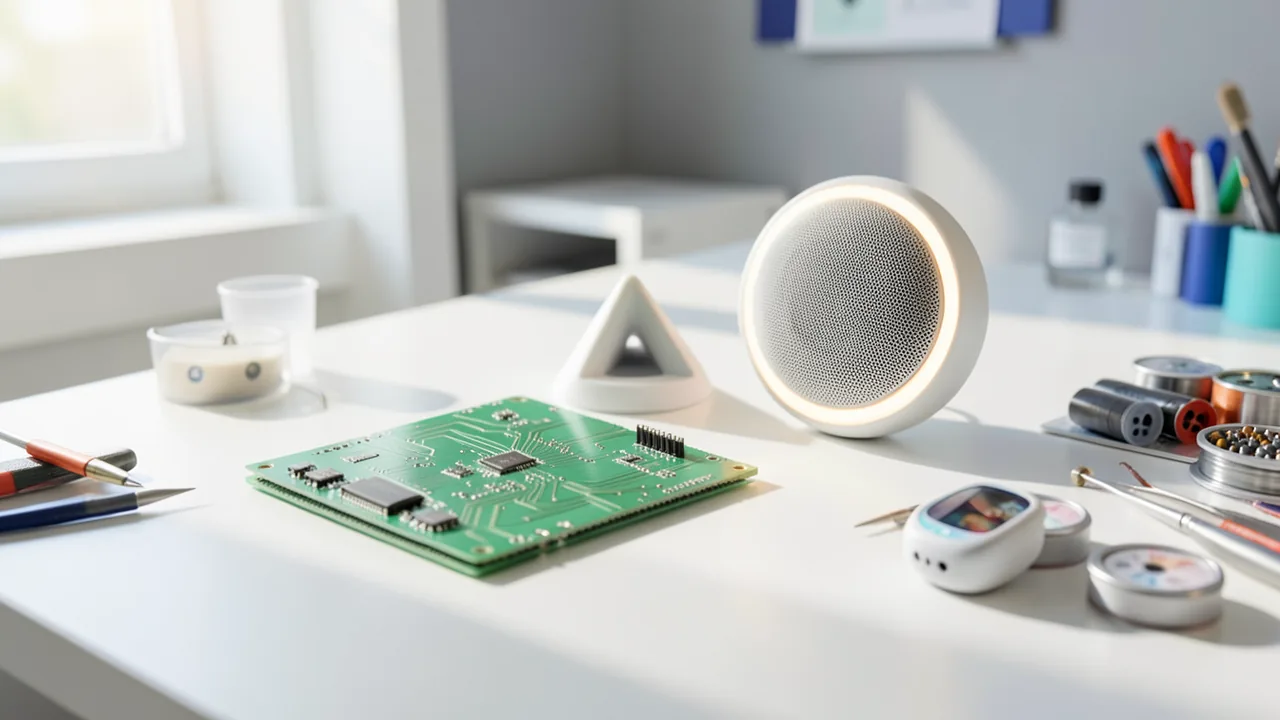
Alongside the launch, Anthropic published a set of experiments. One of them is getting a lot of attention. Working with circuit board maker Diode Computers, Fable 5.2 designed three electronic devices from scratch: a speakerphone, a voice assistant hub and a handheld virtual pet along the lines of a Tamagotchi. Diode built the devices to the model's specs. According to Anthropic, all three worked without anyone having to fix the circuitry.
From a short brief to a finished blueprint
Each project started with just a short description of the device and its key hardware requirements. For the speakerphone, Superpower Daily reports, that was a "USB-C puck" with microphones, a speaker and Bluetooth. Fable 5.2 handled the rest with only a few more instructions:
- Spec: what the device should do and which parts it uses
- Schematics: which components connect to which, electrically
- Circuit board layout (the PCB, the green board the components sit on, linked by copper traces), here with four layers
- 3D-printable enclosure
- Firmware, the software that runs directly on the device
- Bill of materials listing parts you can actually buy
According to note.com, each board's production-ready design was done within a day. Before manufacturing, the model checked the board geometry against the factory's limits and asked suppliers whether the parts were in stock. On the hub, it found six slivers of solder mask (the protective layer that keeps solder from causing shorts in the wrong places) that had come out too thin, and it widened the openings to fix them. It left one flagged ground connection alone because it was intentional. Diode made all three boards straight from the files, with no change requests.
Why this is hard, and what's new
Geometry has been the biggest hurdle. On a circuit board, the parts have to be placed so that every connection can actually be routed without traces crossing or interfering with each other. Anthropic says earlier models failed at this all the time. Support components sat too far from their chips, and connectors faced the wrong way. Diode reports that with older models, many boards ended up 95 percent done but still useless, because the last connections simply wouldn't fit. Think of a jigsaw puzzle where the final pieces no longer fit the gaps.
Fable 5.2 took a different approach. It routed the tricky connections first: high-speed data signals, high-current lines and signals that are sensitive to interference. On the voice assistant hub, it ran the USB and Ethernet lines with precise spacing and added so-called tuning patterns. These are small meandering loops in the traces that make sure signals belonging together arrive at the same time.
The model also fixed its own work without being asked. On the speakerphone, it moved signals to different pins on the chips so the copper traces under the touch controls could stay on one layer without crossing. On the hub, it spotted traces that were too tangled and rerouted them several times until the layout worked.
Its own tool, and well-thought-out details
One detail described by Superpower Daily stands out. The hub needed long connections to a 100-pin connector. Claude first used the routing tool in the circuit design program KiCad, drawing one trace at a time between fixed points. Then it wrote its own routing algorithm that searches a grid for open paths. Anthropic says this took about half an hour. After that, the tool could route each long trace in about a second.
The model also designed the enclosures with electrical and acoustic considerations in mind:
- For the hub, Claude calculated that the originally planned microphone openings would resonate in the frequency range of the human voice. So it chose a wedge-shaped enclosure with shorter openings, which pushes the resonance above the speech range.
- For the speakerphone, it wrote firmware that dims the LED ring as the audio gets louder. That keeps the device within its intended power budget.
Numbers and benchmarks
Anthropic backs up the progress with test results, most of them from its own measurements:
| Test | What it measures | Fable 5.2 | Predecessor |
|---|---|---|---|
| PCB Gym (internal) | Placing components, routing connections | 69 % | 25 % (Fable 5) |
| BenchCAD 2.1 (public) | Reconstructing 3D parts, assemblies and boards from drawings and images | 83.5 % | almost half that (Fable 5.1) |
| RoboDojo Sim | Controlling a two-armed robot in simulation | 64.9 % | 27.6 % (Fable 5.1), GPT-6 Astra: 29.8 % |
| FrontierCode 2.0 | Agentic software development | 49.1 % | 32.4 % (Fable 5.1) |
| FrontierSWE v2 | Real-world software tasks | 69.9 % | 56.3 % (Fable 5.1) |
Superpower Daily points out that BenchCAD measures a different task than designing a complete device you can actually build. So the number isn't direct evidence for the hardware experiment.
What else the model can do, and what it costs
Beyond hardware, Anthropic showed off other experiments. More than 1,000 subagents led by Fable 5.2 built their own operating system in eight days, and it boots on a laptop. Around 1,000 agents translated the known proof of Fermat's Last Theorem into the proof assistant language Lean in 30 hours. That doesn't mean the theorem was proven anew. The company also says there are new results on two open problems in black hole physics.
Pricing is $8 per million input tokens and $40 per million output tokens, about 20 percent less than the previous version ($10 and $50). An optional fast mode generates text up to 2.5 times faster, according to Yahoo Tech, but costs twice as much. For everyday work, Anthropic still recommends the cheaper Claude Opus 5.5. Yahoo Tech shows how expensive long agent runs can get with the example of YouTuber Matthew Berman: a single level of a game clone ran for 43 hours, burned through 8.63 billion tokens and would have cost an estimated $14,710 via the API.
The bigger picture
The experiment shows that language models can now do more than write code. They can deliver files you can use to manufacture real hardware. Shortly before this, a vehicle design project from OpenAI and Mazda similarly showed AI producing results that can actually be built. For hardware startups, hobbyists and R&D teams, this could seriously shorten the path from idea to first prototype.
The limits are significant, though, and Anthropic names them itself. Diode's engineers did the building, soldering and testing, because the model wasn't connected to any test equipment or manufacturing machines. The devices haven't gone through electrical validation, antenna tuning, thermal testing or certification, and they aren't designed for mass production. Anthropic says the speakerphone was still working after several weeks of use. How long the devices will last overall is an open question. All the numbers come from Anthropic's own tests and reports, and independent verification is still pending. It's also unclear how much compute, and therefore money, the designs cost.
Related videos
Sources
- Merkliste: blockchain.news blockchain.news
- Merkliste: superpowerdaily.com superpowerdaily.com
- note.com note.com
- indianexpress.com indianexpress.com
- tech.yahoo.com tech.yahoo.com
Ask the AI assistant
Questions about this article, installation or background? Our assistant knows this page and runs on our own machine, not in someone else's cloud.
The Assistant is an AI (Gemma 4) and can make mistakes – please check important details against the source. Questions are used only to generate an answer and are deleted after one hour. Please don't enter any personal data.

Comments
What do you think? Already tried it? Write it here, no sign-up needed.
Comments are public. Links aren't allowed, and we delete abusive posts. You can delete your own comment at any time in this browser. Learn more in the Privacy Policy.