
Jeep owner lets Claude hack his 32-year-old car to pass a smog test
A California tinkerer used Claude and Codex to get his 1994 Jeep Cherokee through the state's strict smog check. The hardware cost $15 at most, and he needed no mechanic and no dealer scan tool. The AI worked out how to talk to the ancient engine computer, analyzed test drives and even wrote code for the memory chip.
What's going on
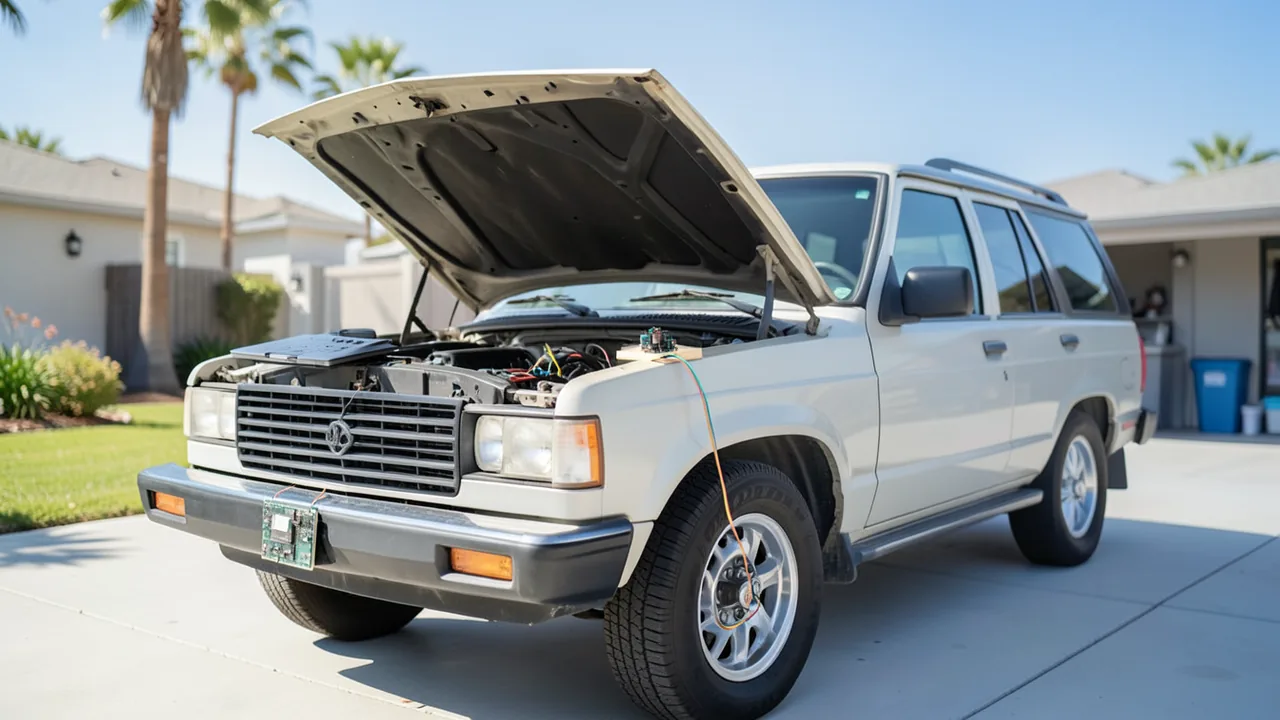
Muhammad Zulali owns a 1994 Jeep Cherokee. The car is 32 years old and kept failing California's smog check, the state's mandatory emissions test. He didn't bring in a mechanic or an expensive dealer diagnostic tool. Instead, he got help from two AI assistants: Anthropic's Claude handled the troubleshooting, and OpenAI's Codex wrote the code he needed. In the end, the Jeep passed. That's according to Tom's Hardware. Zulali documented the whole process in a video and released the code as an open-source project.
He's modest about his own part:
"Claude did most of the diagnostic work and Codex did pretty much all of the memory work. I just did the wiring and the driving."
The problem: too much NOx and pricey retests
At certain test speeds, the Jeep emitted too much NOx. That's nitrogen oxides, pollutants that form mainly when combustion temperatures in the engine run high. On the first attempt, the car failed at 25 mph (about 40 km/h). Zulali then adjusted the air-fuel mixture, and things got worse: on the next test, the Jeep failed at both 25 and 50 mph (about 80 km/h).
Zulali admits he was basically changing settings blind. That got expensive fast, since every new test appointment cost almost $100. And you can't just plug an early-'90s engine computer into a modern diagnostic port. Today's standard, OBD-II, only arrived later.
How Claude found a way into the engine computer
The first question was how a modern laptop could talk to such an old car at all. Claude explained that the Jeep's ECU (engine control unit) speaks over the Chrysler SCI bus. That's a proprietary data line. It runs at about 7,800 baud, or roughly 7,800 signal changes per second. Its signals are also electrically inverted: where a normal serial port expects "on," the car sends "off," and vice versa.
An Arduino Nano, a tiny microcontroller board that costs about $3, handles that translation. Zulali mounted it on a breadboard, a board you can build circuits on without soldering. He ran three of the handful of wires needed to the Cherokee's six-pin diagnostic connector. According to Tom's Hardware, the hardware cost no more than $15 in total.
The connection worked on the first try. At first, though, the system only showed two values: coolant temperature and battery voltage. That wasn't enough for an emissions diagnosis, and Zulali also wanted to be able to change settings.
Dead ends, test drives and tinkering with the engine computer
The troubleshooting wasn't a straight line. According to the report, there were some false leads along the way. One was a diagnosis that the engine was running "too rich," getting about 22 percent too much fuel. But that assumption was based on data from other vehicle models and didn't apply to this Jeep. It shows where even helpful language models stumble: they sometimes apply knowledge to cases where it doesn't hold.
So Zulali changed tactics. Instead of guessing, he had Claude collect real data from test drives. The AI logged engine data and fault codes at 25 and 50 mph, exactly the speeds where the Jeep had failed. Zulali went a step further and let Claude control values like fuel pressure directly. That's what the title of his video refers to: "Claude reverse-engineered my 32-year-old Jeep. Then it started driving it."
This kind of work is called reverse engineering: figuring out how a system works on the inside without any documentation.
The EEPROM trick
The result was a credible diagnosis with a proposed fix. Zulali then wanted to reflash the engine computer, meaning install modified firmware that would let the Jeep pass every emissions test. But his unit was just a few months too old: only slightly newer ones have rewritable firmware.
Codex came up with the solution. The AI wrote custom code and slipped it into a neighboring EEPROM so it would run from there. An EEPROM is a small memory chip whose contents can be electrically erased and rewritten, and it keeps its data even without power. Tom's Hardware doesn't go into the technical details. For that, you'll have to watch the video or read the code.
The code is public
Alongside the video, Zulali set up a GitHub repository called "xj-scanner." "XJ" is the internal designation for this generation of the Cherokee. The project is free software under the GPLv3 license: anyone can use, modify and share the code, but modified versions must be released under the same license. If you own a similar Chrysler or Jeep model from that era, you can at least try to read out your own vehicle with it.
Our take
This story is a vivid example of what AI assistants let hobbyists do in 2026. Until now, a project like this required specialist knowledge of old bus protocols, electronics and embedded programming (writing code for small built-in chips), or a professional shop with dealer tools. Here, a laptop, a $3 microcontroller and two chatbots were enough. The division of labor is interesting too: Claude as the diagnostic partner that explains and analyzes, and Codex as the programmer that takes on the memory work.
There are caveats, though. The story rests on one hobbyist's account. There's no way to verify from the outside how well the fix holds up over time. The false leads show that the AI makes mistakes too. If you trust it too quickly, you could end up changing the wrong values, and in a moving car that's no harmless error. Zulali let the AI control fuel pressure during real drives. If you want to try something similar, be very careful.
The legal side is tricky too. Tampering with engine controls that affect emissions is strictly regulated in many countries. According to the report, Zulali was aiming to actually fix the emissions problem, not to cheat the test. Still, if you're planning something similar, check what's allowed where you live first. Bottom line: it's a remarkable example of how AI tools are opening up expertise that used to be locked behind expensive shop equipment.
Related videos
Sources
- Merkliste: tomshardware.com tomshardware.com
- Merkliste: dev.ua dev.ua
- Merkliste: gadgetreview.com gadgetreview.com
- Google News (FR) news.google.com
- Bing News (ar-SA) erembusiness.com
- ITHome (CN) ithome.com
Ask the AI assistant
Questions about this article, installation or background? Our assistant knows this page and runs on our own machine, not in someone else's cloud.
The Assistant is an AI (Gemma 4) and can make mistakes – please check important details against the source. Questions are used only to generate an answer and are deleted after one hour. Please don't enter any personal data.


Comments
What do you think? Already tried it? Write it here, no sign-up needed.
Comments are public. Links aren't allowed, and we delete abusive posts. You can delete your own comment at any time in this browser. Learn more in the Privacy Policy.