
Code over pixels: When Claude, Gemini and GPT make better illustrators
Language models now draw posters, diagrams and even Blender scenes by writing code, and you can edit the result however you like afterwards. We went through benchmarks, cost figures and hands-on reports: for text, numbers and diagrams, code wins clearly. For photos, faces and textures, image models stay ahead, and code isn't cheaper either.
What this is about
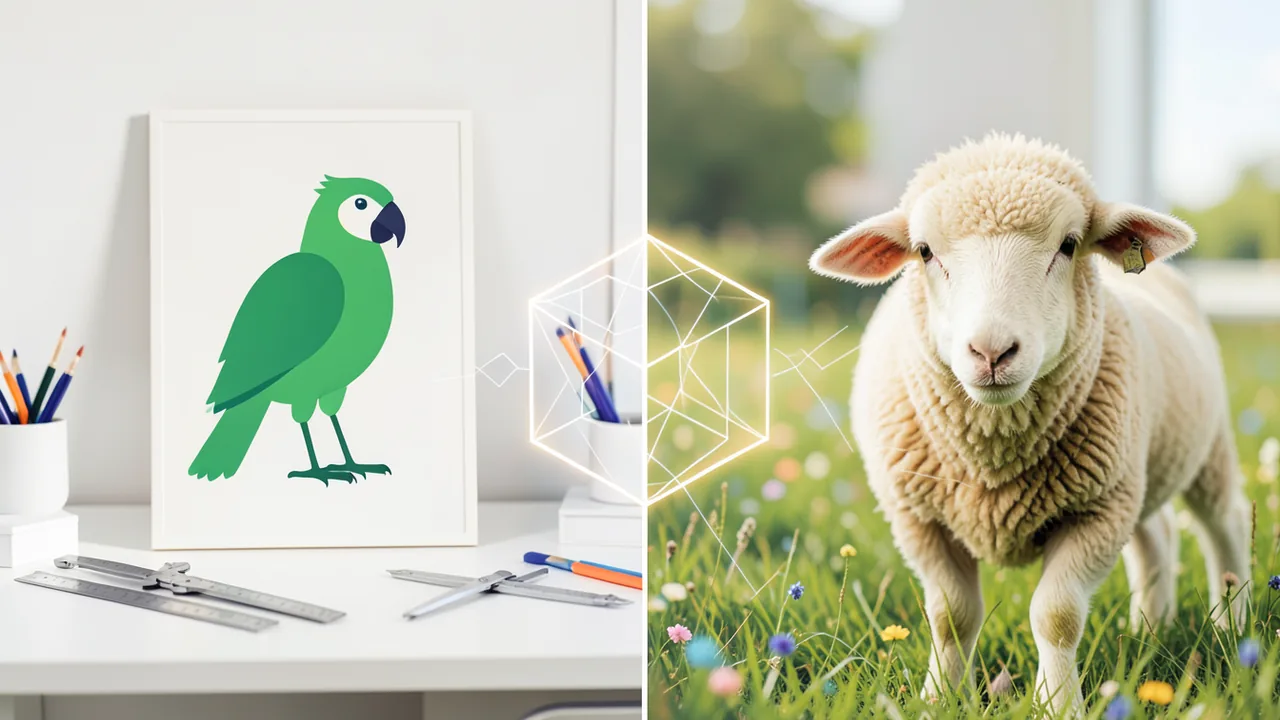
If you want an image from an AI, you usually reach for an image model: GPT Image 2, Nano Banana, Midjourney. These models deliver a finished raster image, a grid of millions of colored dots. Since the second half of 2026, there's been a second approach worth taking seriously. Large language models like Claude Opus 5.5, Gemini 4 Neon and GPT-6 Astra don't draw at all. They write code that produces the image: SVG (a text-based vector graphics format in which every line and every letter is described individually), HTML, Three.js or Python scripts for the 3D program Blender.
Simon Willison, a developer and one of the best-known AI bloggers, summed it up on November 28: images made from code are “more useful than images from specialized image models”. We look at where that holds up and where it doesn't, including the time and cost that usually get lost in the enthusiasm.
A note on transparency: We had planned our own comparison test, giving the same tasks to three language models and three image models. We couldn't run it for this article. According to its model card, Nvidia's Nemotron-Labs-Image needs four H100 GPUs, and Ming-Image needs a card with 80 GB of memory. So we're not showing our own measurements. Instead, we've pulled together published benchmarks, vendor figures and documented real-world runs. At the end, you'll find a test protocol so you can reproduce the tasks yourself.
The example: a kakapo poster in three rounds
Willison asked Gemini 4 Neon in Google's AI Studio for an SVG poster for the conservation program of the kakapo, a flightless parrot from New Zealand, in a 1970s graphic style. He had the model do research first. The published transcript shows three rounds:
- An 800 × 1120 pixel poster with retro-style arcs, a rimu branch and a bar of statistics. The bird, however, looked like a cartoon owl.
- When asked, the model looked up reference images and built an anatomically more accurate head.
- A subheading overflowed its pill-shaped container. The reason: Willison's viewer had swapped the requested fonts, Futura and Century Gothic, for wider fallback fonts. Gemini widened the container (656 pixels) and shrank the text to 13.5 pixels.
Willison fact-checked the numbers on the poster and considers them correct. But his main argument is a different one: every piece of text and every shape can then be changed directly in the code or in Inkscape, Illustrator or Boxy SVG. Still, the run exposes two weaknesses. AI Studio doesn't render SVGs, so the model couldn't see its own mistakes and needed screenshots. And text in code is only truly reliable if the right font is actually installed on the target machine.
Who wins where: our comparison
The sources paint a fairly clear picture. The table is our summary, not a measurement:
| Task | Code (SVG/HTML/Blender) | Image model (pixels) | Evidence |
|---|---|---|---|
| Text with umlauts and accents | letters are real characters, so always spelled correctly; risk: missing font | much improved, but according to the Nemotron card, text “may be incorrect” | Willison transcript, Nemotron model card |
| Exactly 13 objects | a loop in the code, count guaranteed | the Nemotron card explicitly warns of wrong counts | model card |
| Diagram, infographic | clearly ahead; even Nvidia routes such jobs to code | good benchmark scores, but remains a flat image | Nemotron paper |
| Editing afterwards | change one line of code, everything else stays the same | every edit can introduce new errors | Willison, Hacker News |
| Photorealism, faces | weak, shapes often stay crude | clearly ahead | Willison, 3DCodeBench, apimodels.app |
| Textures, fine detail | laborious, easily lost | clearly ahead | SVG research, Hacker News |
Nvidia is particularly revealing. The paper on Nemotron-Labs-VisualCreation describes a router: a model decides whether a request is a natural image or a structured surface such as a diagram, a slide or a web page. Only natural images go to the image generator. Everything else is built as code, with embedded raster images where needed. So even a maker of image models considers code the better tool for diagrams. One detail from the paper: the system reaches its top score on the business graphics benchmark BizGenEval (86.0) only when paired with GPT-6. With Nvidia's own models alone, it scores 64.7, behind GPT Image 2 and Nano Banana Pro. So far, only the image generator has been released, under a research-only license. According to the model card, the code component will follow only after legal clearance.
Image models are catching up from the other direction. Ideogram 4.0 accepts instructions in JSON format, where each element gets a bounding box, a rectangle with fixed coordinates, and each piece of text gets its exact wording. Willison added this to his post after a tip on Hacker News. According to its model card, Ming-Image-0.2-Design breaks designs down into transparent layers and works with Figma-style prompts. The result is still an image, though: Ideogram needs separate tools to turn recognized text back into editable layers.
What the benchmarks say, and what they don't
The public benchmarks are inconsistent, and some are outdated:
- SGP-GenBench (arXiv 2509.05208) measures how well language models turn text into SVG, including counting and spatial relationships. Result: performance grows with general coding ability. But the models tested date from 2025, such as Claude 3.7 Sonnet (84.8 points on the composition test). An image model like Qwen-Image appears only as a single example image, without scores.
- SVGenius (arXiv 2506.03139) shows that all models drop off significantly with more complex graphics. When recreating an image as SVG, GPT-4o fell from 23.4 to 11.7 points going from easy to hard. Style transfer was the hardest task for everyone.
- 3DCodeBench (arXiv 2606.01057) from Google DeepMind tests Blender code. About 70 percent of scripts ran on the first try, 97 percent with error feedback. But the authors stress that agent environments like Claude Code fix programming errors while barely improving the shape of the objects. Typical failures are floating parts and misaligned components. The models are good at writing 3D code, but bad at working out from visual differences what's wrong with a shape.
- Frontier3DBench (arXiv 2611.09017) confirms this with newer models. GPT-6.1 Sol leads with 66 out of 100 points. All systems are weakest at faithfully recreating a reference.
Research is targeting exactly this gap. The IR4RL method (arXiv 2609.34587) rewards models during generation for bringing the intermediate render closer to the reference. So far, it only works for SVG and TikZ, a drawing language for scientific graphics.
The bill: code is rarely cheaper
Most success stories leave this part out. We lined up the available numbers:
| Task | Time | Cost | Source |
|---|---|---|---|
| SVG pelican, Gemini 4 Neon (xhigh) | 3:47 min | 39.83 cents (26,546 output tokens) | Willison's comparison page |
| SVG pelican, Gemini 4 Hydrogen (xhigh) | 2:36 min | 23.61 cents | same |
| GPT Image 2, 1024², high quality | approx. 104 s (one user report) | approx. $0.21 | Apidog |
| GPT Image 2, medium quality | – | approx. $0.05 | Apidog |
| Ideogram 4.0 via API | – | $0.03–0.10 | Ideogram |
| Blender object, GPT-5.5 (3DCodeBench) | – | approx. $0.28–0.32 per request | 3DCodeBench |
| Blender animation, Fable 5.2 | 2 h 44 min | approx. 1.1M output tokens | apimodels.app |
At 1.1 million output tokens, Fable 5.2's list price ($40 per million, according to Orkas) works out to about $44. A reseller's discounted price comes to around $26. One user on X reports 108 minutes, 1.03 million output tokens and around $90 for a sea serpent animation. By these numbers, a single SVG costs roughly twice as much as a high-quality GPT Image 2 image and takes longer. And Willison's poster only got there in the third round.
Our take: Code doesn't pay off on the first image, it pays off on the fifth revision. Changing a year or a word on an SVG poster costs a handful of tokens and leaves everything else untouched. A Hacker News user describes the flip side with image models: every edit produces a “copy of a copy of a copy.”
The Blender case: photorealism only as a team effort
The strongest counterexample to “photos only with pixels” is a post on r/ClaudeAI: an animated, photorealistic lamb made in Blender. The author says he never opened the program himself. An agent running Fable 5.2 and Opus 5.5 controlled Blender via Blender MCP, an interface that lets an AI operate the program directly. Rendering was done on an RTX 5080. According to a summary on AGI Hunt, the agent wrote its own Python tools for about 500,000 wool strands and roughly 30,000 finer hairs. It also built teeth, a tongue and a movable jaw for a chewing animation.
But the case is a hybrid. The base mesh came from Tripo AI, a generative 3D model, and the rig from Hyper3D's AI AutoRig. The costs: $4.76 in generation credits, one auto-rig run, two five-hour usage windows of Fable 5.2 and one of Opus 5.5. The post doesn't say how many iterations were needed. The author's conclusion, roughly: the language model is the hand, the human is still the head.
Similarly candid is a Chinese report on woshipm.com about a presentation built entirely in HTML, CSS and JavaScript, created in 42 minutes from a single prompt. According to the report, it was built by an “Opus 5.6” that hasn't been officially released, so that's unconfirmed. The author himself points out weak audio and problems with stability and character consistency.
How to test it yourself
If you want to settle the question for your own work, give four tasks each to a language model (asking for SVG or HTML) and to an image model:
- A poster reading “Summer fête – Greetings from Überlingen, free entry for children under 12.”
- An infographic with exactly 13 eggs in three rows.
- A flowchart with seven labeled steps.
- A photo of an older woman inspecting apples at a market.
Note the time, cost, errors, and how much effort the follow-up edit “Change 13 to 14 and Überlingen to Lüneburg” takes. Based on everything the sources suggest, code wins the first three tasks and the image model wins the fourth. That's an expectation, not a measured result.
Our verdict
For posters with fixed text, diagrams, infographics, slides, UI mockups and stylized game art, code is now often the better choice. Spelling, counts and layout are no longer a gamble, and every correction is a small tweak rather than a fresh roll of the dice. Photorealism, faces, skin and fine textures remain the domain of image models. Even advocates like Willison concede that, and the 3D benchmarks back it up with numbers. Code isn't cheaper or faster for the first draft. And without a render loop in which the model sees its own output, it needs human screenshots as feedback.
The open question is how long this division will last. Image models are getting layers and layout coordinates, language models are learning from rendered intermediate states, and Nvidia is building both into one system. Our take: the question “image model or code?” is turning into the question of which parts of an image need to be pixels and which don't.
Sources
- Simon Willison: Code-driven AI illustrations simonwillison.net
- Gist: Transkript des Kakapo-Plakats gist.github.com
- Simon Willison: LLM inflection points simonwillison.net
- Simon Willison: Vibe game development simonwillison.net
- Gemini 4 SVG thinking-level comparison static.simonwillison.net
- AGI Hunt: Blender-Lamm mit 500.000 Wollsträhnen agihunt.info
- Reddit r/ClaudeAI: An Animated Lamb in Blender With Fable 5.2 reddit.com
- apimodels.app: Claude Fable 5.2 Use Cases apimodels.app
- Orkas: Fable 5.2 Motion Graphics orkas.ai
- 36Kr: Fable 5.2 Text-to-Video eu.36kr.com
- woshipm: Claude Opus 5.6 PPT woshipm.com
- Hugging Face Paper: Nemotron-Labs-VisualCreation huggingface.co
- Hugging Face: nvidia/Nemotron-Labs-Image-30B-A3B huggingface.co
- Hugging Face: inclusionAI/Ming-Image-0.2-Design huggingface.co
- Ideogram 4.0 ideogram.ai
- Claude Design claude.com
- arXiv: SGP-GenBench arxiv.org
- arXiv: SVGenius arxiv.org
- arXiv: 3DCodeBench arxiv.org
- arXiv: Frontier3DBench arxiv.org
- arXiv: Reinforcement Learning from Intermediate Renders arxiv.org
- Apidog: GPT Image 2 Preise apidog.com
- explainx.ai: Code-Driven AI Illustrations explainx.ai
Ask the AI assistant
Questions about this article, installation or background? Our assistant knows this page and runs on our own machine, not in someone else's cloud.
The Assistant is an AI (Gemma 4) and can make mistakes – please check important details against the source. Questions are used only to generate an answer and are deleted after one hour. Please don't enter any personal data.

Comments
What do you think? Already tried it? Write it here, no sign-up needed.
Comments are public. Links aren't allowed, and we delete abusive posts. You can delete your own comment at any time in this browser. Learn more in the Privacy Policy.